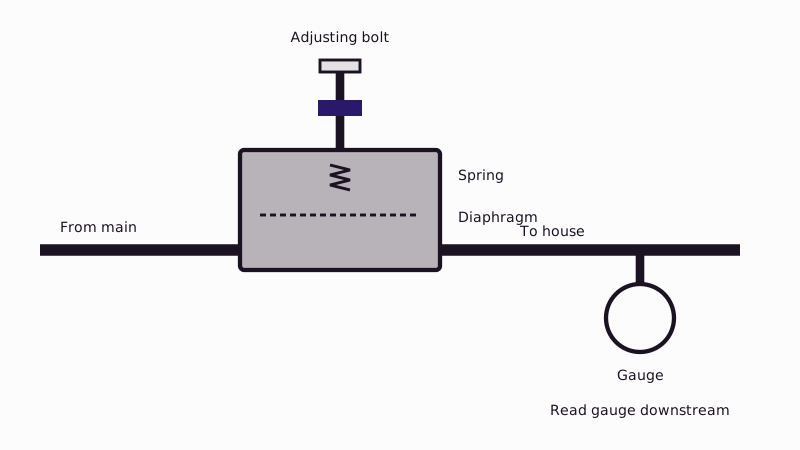
Screw the adjusting bolt on top of the regulator clockwise to raise water pressure and counterclockwise to lower it, checking a gauge on the exterior hose bib, rechecked after each small turn. Aim for 45 to 60 psi at rest. If the gauge climbs above that when nothing is running, or the dial won't hold a setting, the valve is worn and needs replacing. Trouble is a weak trickle rather than too much force? Begin with low water pressure.
What is the job of the bell-shaped valve at the main?
A regulator is a brass valve shaped like a bell, installed just downstream of the main shutoff, and it trims the street pressure down before it reaches your plumbing. A spring and a diaphragm inside push back against the incoming flow and ease off as demand changes, which keeps faucet pressure near the setting.
Street pressure can run well above what household plumbing is built for, which is why the valve exists. The EPA's WaterSense program says high pressure can damage piping, fixtures and appliances and push water use up. California Plumbing Code section 608.2 calls for a regulator when static pressure exceeds 80 psi. Other names for the same part: pressure reducing valve, PRV, pressure reducer, and in some catalogs a Watts-style regulator. A small inline unit that screws onto a garden hose is a different product and does nothing for the house.
Where is the regulator located in a house?
Follow the supply from where it enters the property. It may be on a garage wall, in a crawl space, in a basement, or in a box near the meter out front. Spot the brass bell with a bolt and locknut crowning it.
Westside homes vary. Hillside houses in Brentwood and Malibu often have it tucked in a garage or under the house, since the lot slopes away from the street. Venice and Marina del Rey bungalows may have it outside in a ground-level box. Plenty of older houses have none at all, worth knowing if the pipes bang. If you can't find it, the regulator location guide lists common spots.
How do you check pressure before touching anything?
Thread a gauge to a hose bib or the washer hookup, make sure nothing in the house is pulling water, and read the dial. A steady 45 to 60 psi is the service pressure range in the EPA WaterSense homes manual. Anything past 80 means the regulator is shot or dialed too high.
Take a second reading at night or early in the morning, because many city systems peak when demand is low. Hillside homes at the bottom of a slope tend to see higher static pressure than those near the top, which is physics, not a defect. If the needle creeps upward over a minute or two with everything off, that's called creep, and the valve seat is leaking. Adjusting won't cure that.
What are the steps to adjust a regulator valve?
Loosen the locknut on the adjusting bolt a turn or two, then turn the bolt clockwise to increase pressure or counterclockwise to decrease it. Make each adjustment about half a turn. Run a faucet for a moment so the spring settles, shut it, recheck the dial, and snug the locknut once the reading is right.
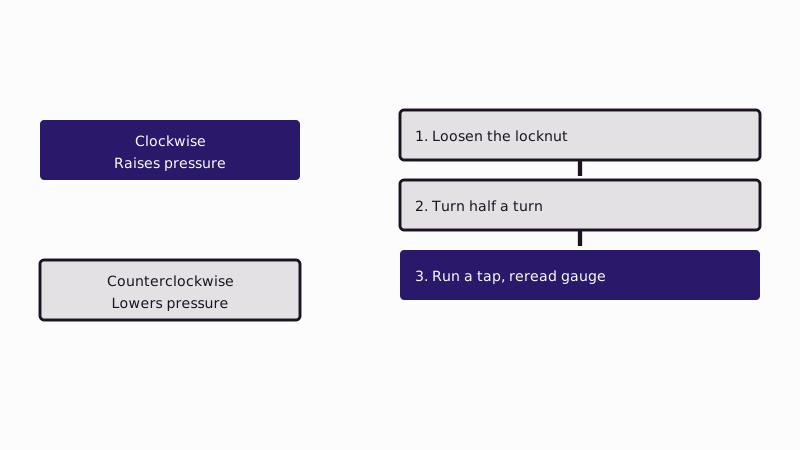
A few details save trouble. The gauge must sit downstream of the valve, inside your own plumbing. Don't chase a number with large turns; the valve responds slowly. Land mid-range, and nearer 50 psi if the house has older pipes or you hear hammering. After the final turn, run a hot tap for a minute and listen for knocking. Fixing the noise itself is covered in water hammer sounds.
Is the regulator bad? How can you tell?
Three signs stand out: a resting reading past 80 psi, a needle that drifts up while the house is idle, or pressure that lurches from trickle to blast. Banging pipes, a heater relief valve that weeps, toilets running on and spitting faucets often tag along.
A regulator also fails the other way, by clogging. Santa Monica's water averages roughly 161 ppm hardness in the city's recent report, and mineral debris can foul the screen and seat. If pressure is low only at the house while the street is normal, a gummed regulator is a common suspect. See low pressure that appears suddenly for the other candidates.
How long does a pressure regulator last, and can you replace it yourself?
Count on ten to fifteen years; mineral-rich water and pressure surges can cut that, so treat the date as a hint and not a deadline. For most homes, a plumber should do the swap, since it opens the main line and, in Santa Monica, probably needs a permit.
Santa Monica's municipal code, Chapter 8.08, requires a permit for altering or repairing building service equipment, with limited exemptions, so a valve swap may fall under it. Call the Building and Safety office to confirm before starting. Fitting a regulator also closes the loop, which can call for a tank to absorb heated-water expansion; see the expansion tank guide. The price of the whole job is on pressure regulator installation costs.
What about shower heads, pumps and whole-house setups?
A shower flow restrictor limits flow volume, not pressure, so a high reading at the main stays high. A booster pump is the opposite tool, built to raise weak pressure. Whole-house units sit at the main and cover every fixture past them.
Some tankless and recirculating systems carry their own regulators too, as do some hot-water lines. One stubborn tap, by contrast, usually has a clogged aerator or cartridge, with the regulator innocent. See whole-house regulators and fixing low pressure in a house.
Common questions
What is involved in replacing a regulator?
The main gets shut and the line drained, the old valve comes out, a same-size replacement goes in facing the right direction, and water is restored slowly while you watch for leaks and read the gauge. Since the work opens the main and normally needs a permit, hand it to a plumber.
What gives away a faulty regulator?
Read the gauge while the house is idle. Over 80 psi, a number that climbs across a few minutes, or big swings during use all point to a failing valve. Noisy pipes and a leaking heater relief valve often come with it, and a correctly sized new unit tends to clear them together.
How many years before a regulator wears out?
Commonly 10 to 15 years in most homes, fewer with hard water or surges. No fixed expiry exists, so put a pressure gauge on once a year and catch drift early. Past ten years with wandering readings, plan on a replacement before it fails outright.
Are a pressure regulator and a PRV the same thing?
Yes. Plumbers use pressure regulator, pressure reducing valve, PRV and pressure reducer for the same device. The hose-end regulators sold for camping and irrigation are a different product, and they do nothing to protect the house plumbing from the supply line.
Back to the Sunset Coast Plumbing home page for everything we arrange across Santa Monica and the Westside.
Sources used
Page updated