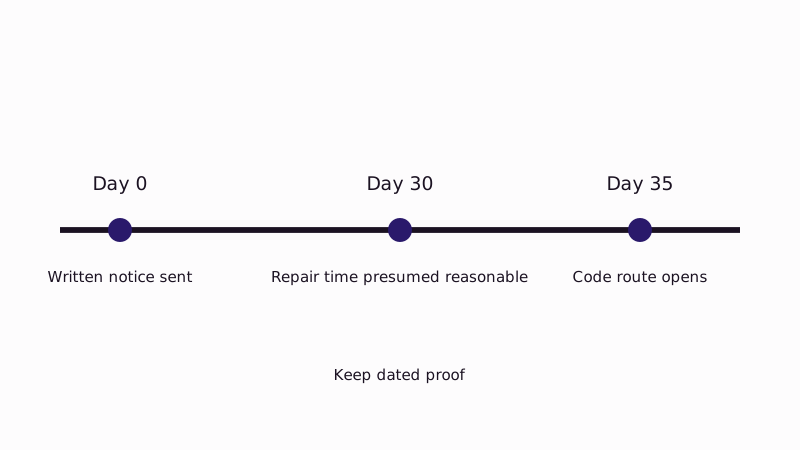
In California the answer is yes: hot water is part of what a rental must have. Civil Code 1941.1 puts a supply of hot as well as cold water on the list of basics for a livable unit and requires plumbing and gas facilities to be kept in good working order. Nothing here is legal advice. Below come the tenant's options, then the repair side, which begins at water heater repair.
Does my landlord have to provide hot water?
Yes. Under section 1941.1 a unit counts as untenantable if it has no water supply able to give both hot and cold water from the faucet, and the wording covers a supply the tenant controls as well as a system the landlord controls. Plumbing and gas facilities must also stay in good working order.
A central boiler in an older building counts just as much as a tank in a closet. The statute is worded a little differently for a supply the tenant controls and a system the landlord controls, but in practice a dead heater is the owner's repair problem, and a lease clause that tries to waive the duty is generally not enforceable.
How long does the landlord have to fix it?
No single deadline exists. Section 1942 asks for repair inside a reasonable time after notice, presumes 30 days to be reasonable, lets that presumption be challenged, and allows shorter periods when circumstances demand. A household with no hot water can argue for speed.
Put that in plain words. A missing part that takes a week to arrive is one thing. A landlord who ignores a message for two weeks is another. Notice matters: the statute counts from the moment the landlord or the landlord's agent learns of the problem, and a written record, even a text message, beats a memory. Date everything, keep copies, and note each time you follow up.
What are my options if nothing gets fixed?
Several paths exist, and each carries limits: repair and deduct under section 1942, a code enforcement inspection, a rent decrease petition where a rent board takes them, or in some cases leaving the unit. Take advice before choosing, because a wrong move costs money.
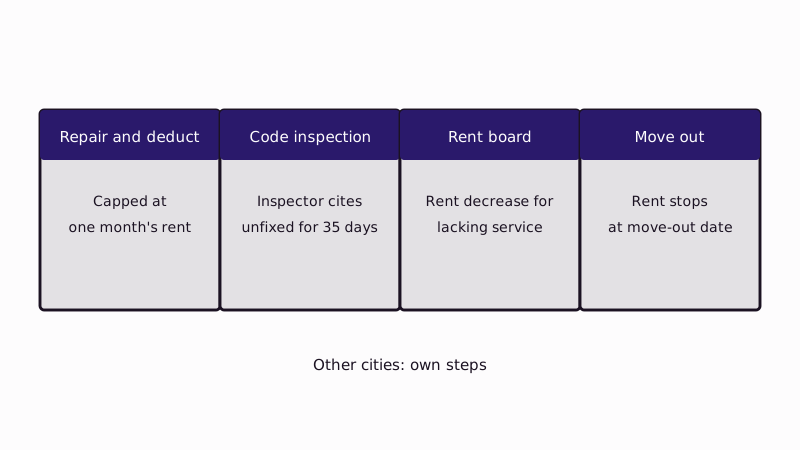
The main options:
- Repair and deduct. The tenant arranges the repair and subtracts the cost from rent, but only if the cost does not exceed one month's rent, and the remedy cannot be used more than twice in any 12-month period.
- Code enforcement. A housing inspector can cite the condition. Under section 1942.4, if an official notice sits unfixed for 35 days without good cause, the landlord may lose the right to demand or collect rent, and damages of $100 to $5,000 plus attorney fees can follow. The statute has conditions, so read it or get advice.
- Santa Monica Rent Control Board petition. The board takes petitions for rent decreases when maintenance is lacking or services are reduced, and its maintenance page lists hot and cold water among the basics. That page says a petition may be filed once 30 days have passed since the owner received written notice from the tenant.
- Moving out. Section 1942 lets a tenant leave instead of repairing, with release from future rent as of the move-out date.
Rules in other Westside cities can differ. West Hollywood and Los Angeles neighborhoods have their own housing and rent departments, and each has its own steps, so check with the department that serves your address before relying on a Santa Monica procedure.
What should the written notice say?
A good notice names the address and unit, says there has been no hot water since a specific date, asks for repair, and states how you can be reached and when someone can enter. Send it in a way that leaves a record, such as email or mail with a delivery receipt, and keep a copy.
Keep the tone factual and list other symptoms, such as a pilot flame that dies, a drip near the tank or a tripped breaker; they help whoever arrives to fix it. In Santa Monica the Rent Control Board's maintenance page advises following up in writing and keeping a signed, dated copy. Photos help, dated if possible. If the landlord says a plumber is coming, ask for the day, and note whether they showed. Withholding rent on your own is risky in California, so talk to a tenant organization or lawyer before you try it.
Who repairs an apartment heater, and for how much?
The landlord or property manager arranges a plumber or a heater technician. A tenant should not open the heater, touch gas piping or electrical connections, or relight a gas pilot on a unit they do not own. The plumber diagnoses first: a pilot, thermostat, element, gas valve or failed tank.
Cause and system size drive the price; expect a number only when the quote is in writing. For a feel of scale on electric tanks, the Rheem electric repair page lists part-by-part ranges, and replacement pricing covers the larger decision. Landlords weighing repair against replacement should know that a replacement generally needs a permit in Santa Monica, which the homeowner guide classes as Single Trade Permit work, and that California requires a contractor license for work of $1,000 or more, or any job needing a permit.
Owners and managers can begin at Sunset Coast Plumbing and see the steps laid out under how a job runs.
What if the problem is not the heater?
On occasion the tank is sound while the fault lives elsewhere: a failed mixing valve, a closed shutoff, a stuck check valve or a recirculation pump in a large building. In those cases hot water may be weak at one fixture, not gone everywhere. The no hot water guide lists common causes.
Test other taps. If only one faucet is affected, the cartridge or supply line may be the culprit, and if it is the whole unit, the heater is the first suspect. Mention what you tested in your notice, since it saves a trip.
Common questions
Can my landlord retaliate if I complain?
California law presumes some actions are retaliatory when they follow a protected complaint, according to legal summaries of section 1942.5, including rent increases or eviction notices within 180 days. Details and exceptions apply, which is why a tenant organization or lawyer should weigh in. Keep your notice and the landlord's reply so the timeline is clear.
Is it safe to wait for the landlord while I have no hot water?
Briefly, yes, but protect yourself. Do not relight a gas pilot or reset electrical parts if you are unsure, and watch for scalding on unexpected surges. Smell gas? Walk out, then ring SoCalGas at 1-800-427-2200 from the street. Anyone in danger means 911 first. For a water leak, close the shutoff and tell the landlord immediately.
Does it matter if the heater is shared by the whole building?
Not for the landlord's duty. A central system under the landlord's control still has to produce hot and cold water. It does change the repair, since a boiler or large commercial heater takes a bigger job, often a longer schedule and more cost. Tell neighbors and ask whether the manager has been notified of the outage.
Can I get a plumber myself and bill the landlord?
Only under the repair-and-deduct rules, which have a notice requirement, a time period and a cap of one month's rent. Doing it outside those rules can cost you the money. Before hiring anyone, read section 1942 or consult a tenant organization, and keep every receipt. A written quote through the quote page shows the cost before you commit.
Sources used
Page updated