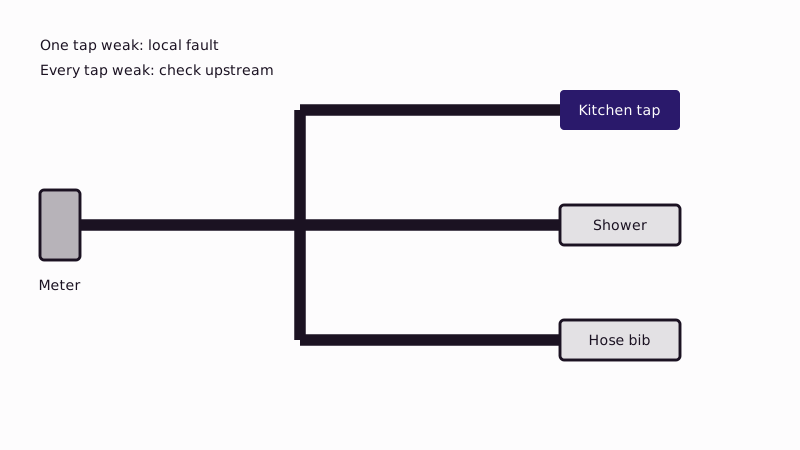
Pressure that sags at every faucet usually traces to the pressure regulator at the house entry, a half-closed main valve, or corroded supply pipe. Pressure that sags at one faucet is nearly always a clogged aerator or cartridge. A plumber settles it with a gauge reading and a walk around the house. Browse our other service lines from the home page; the quote form is there once one of these patterns fits you.
One tap weak, or every tap?
Test two or three fixtures at the same moment. If only the kitchen faucet is feeble, the fault is local: a clogged screen, a worn cartridge, a kinked supply hose. If the shower, the laundry and the hose bib all drag, the trouble lies upstream of the house: the supply main or the regulator.
A second split helps: cold only, or hot too? Weak hot water with normal cold narrows things to the heater, its valves, or a scaled-up hot line. Our notes on low hot water pressure and a weak kitchen faucet take those branches in turn.
Timing matters too. A slow decline across months reads as scale or corrosion building inside old pipe. A drop that happened overnight reads as a closed valve, a failed regulator, or a leak, and pressure that suddenly vanishes deserves a same-week visit.
Who do you call when the pressure drops?
Call a plumber, but start with the utility if neighbors have the same trouble. A street-wide dip is the water department's business; a dip inside your property line is the plumber's. In Santa Monica that utility is the city's own Water Resources division. Brentwood and parts of the Westside sit on LADWP instead.
Santa Monica draws up to three quarters of its supply from groundwater wells and blends in imported water, according to its annual report, so a main break or pump repair can pinch a block without touching the next. Phone the utility first when the whole street is weak.
Past the meter, the pipe and valves are the homeowner's property, and the plumber tests them cheapest-first.
What does a plumber check, in what order?
A gauge goes on a hose bib or laundry spigot to read static pressure. Next comes a look at whether the main shutoff handle is wide open, an inspection of the regulator, flow tests at several fixtures, and tracing of any suspect run. Findings come back as a short list with a quote for each fix.
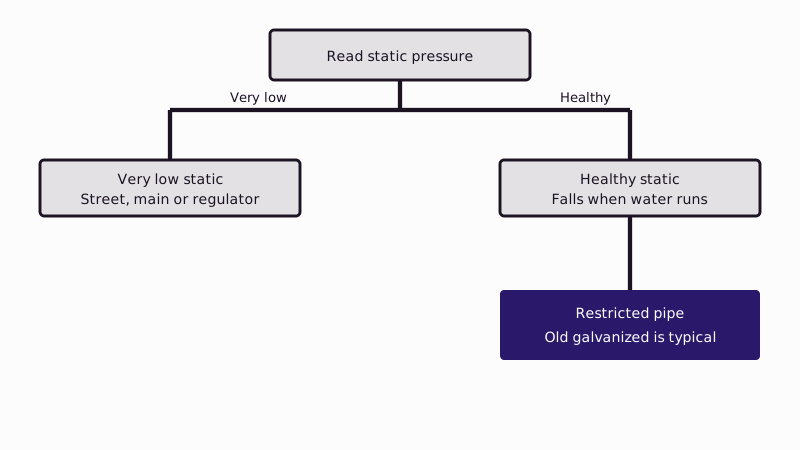
The gauge number is the anchor. Very low static pressure points toward the street, the main or the regulator. Healthy static pressure that collapses when water runs points to a restriction in the pipe, which is typical of old galvanized lines.
Westside houses offer plenty of examples. Plenty of 1920s to 1950s homes retain galvanized steel supply pipes with bores narrowed by rust, so the water arrives at the meter strong and reaches the tub weak. Copper from later decades has its own failure mode, pinhole leaks, which can also bleed pressure.
undefined
What is a pressure regulator and why does it fail?
A regulator (the trade also says pressure reducing valve, or PRV) is a brass, bell-shaped valve that normally sits just inside the point of entry for the main. It trims street pressure to a level fixtures can live with. Its internal diaphragm wears, and a failed unit can let pressure either crash or spike.
Where one lives is a common search of its own, and homes with a whole-house regulator often have it by the meter box, the front hose bib, or the garage wall nearest the street. Many homes have none at all.
Some owners try turning the adjustment screw themselves, and adjusting a regulator step by step shows how far to go. If the unit is old, buzzing, or leaking at the bell, replacement beats adjustment. Typical life is measured in years, not decades, and the manufacturer's data sheet for your model is the honest source for its rated life.
What will the repair bill look like?
Whatever the gauge finds decides it. A cleaned aerator or reopened valve is close to a service-call charge. A regulator swap costs more, and repiping a corroded house costs far more. Cost pages give national ranges, and the written quote prepared for your home sets the actual price.
Because the cause drives the bill, we avoid quoting a number before anyone has measured. Our regulator installation cost page shows how regulator jobs are priced, and for a whole house on old pipe, the guide to what repiping costs is the better benchmark.
A new main line costs enough to cross California's $1,000 trigger for a contractor license. Confirm the plumber's license with the state licensing board before work, and remember the deposit ceiling: capped by law at a tenth of the contract or $1,000, whichever comes first.
Why is pressure low in Brentwood and Malibu hills?
Elevation changes pressure by about a pound for every two and a third feet of height, so a hillside house near the top of the system gets less than one at the bottom. Homes at the foot of a canyon often need a regulator to tame excess pressure, while those near the crest may need a booster pump.
Slope also changes where a plumber looks. Long, branching runs feed far bathrooms, and gravity works against upstairs fixtures. On a hill, a house with a failing regulator can look as if the terrain were to blame, so the gauge reading matters more than any guess.
In Santa Monica's flatter neighborhoods the pattern is different: scale in old pipe and aging galvanized lines are the usual suspects. The city softens its groundwater with reverse osmosis, per its water quality report, which helps scale in the hot side, but it does not rejuvenate pipe that has been rusting for sixty years.
Can sprinklers or a bad showerhead be the real problem?
Yes. A sprinkler zone that sprays weakly shares the same pipe, so a leaking head or an overloaded zone will drop pressure to the rest. A showerhead with a flow restrictor or clogged holes can mimic a house-wide problem, so test with the head off before blaming the plumbing.
A good low-flow showerhead is not a defect. Water-saving heads limit flow on purpose, and the EPA WaterSense label marks models that stay effective at lower flow. If the pressure at the pipe is fine and the spray is weak, the showerhead is the answer, and no plumber is needed.
Does low water pressure hurt your plumbing? Sustained low pressure is rarely dangerous to pipes on its own, but it can signal a leak or sediment, and it makes water heaters and appliances work poorly. Excess pressure is the one that damages fixtures and supply hoses.
What should you have ready before the visit?
Know which fixtures are weak, when it began, and whether neighbors share the trouble. Locate the main shutoff and make room around it. Jot down the house's age and any earlier repipe. A phone photo of the meter box and the area around the regulator saves time.
We staff the phones Monday to Friday during office hours. The sequence from first call to final signature is laid out in the step-by-step job outline.
Common questions
Is there a set age for replacing the regulator?
There is no universal figure. Regulators wear at different rates depending on the pressure they handle, the water chemistry and the model. A unit that is noisy, leaking at the bell or no longer holding a steady gauge reading is due for replacement. The manufacturer's data sheet for the exact model is the safest source.
Can a plumber fix low pressure from a broken water pipe?
Yes, provided the break is downstream of the meter. A leaking supply line bleeds pressure; the plumber finds it, swaps the damaged section and retests the line. A rupture in the street main is the utility's job, so tell the water department promptly.
How do you spot a dodgy plumber on a pressure job?
Be wary of anyone who names a price before measuring, wants cash with no paper, or asks for more than the legal deposit cap. Insist on a written quote, request the contractor's license number, and run it through the licensing board's lookup before you pay.
Does drinking water affect low blood pressure?
That question is medical, so it sits outside plumbing. Staying hydrated is a general health matter, and a doctor is the right person to ask about blood pressure in the body. Everything on this page concerns water pressure in pipes only, nothing about people.
More in this guide
- Water pressure and valves
A fix ladder for weak water pressure, from free checks to a booster pump, with the hillside physics that explain why Brentwood and Malibu…
- Sudden low water pressure
Pressure fell overnight? Check neighbors, meter valve, regulator and hot side in about 15 minutes.
- Water pressure and valves
Where the pressure regulator hides in a Santa Monica home: follow the pipe from the meter, check garage and utility spots, and learn how…
- Pressure regulator
A whole house water pressure regulator holds street pressure at a safe level.
- Water pressure and valves
Adjust a home pressure regulator with a gauge and one wrench: target psi, the turn direction, signs of failure, and when replacement needs…
- Water pressure and valves
Published guides put a water pressure regulator install near $200 to $700.
- Water pressure and valves
Low water pressure at one tap, the whole house or only hot water points to different causes.
Sources used
Page updated