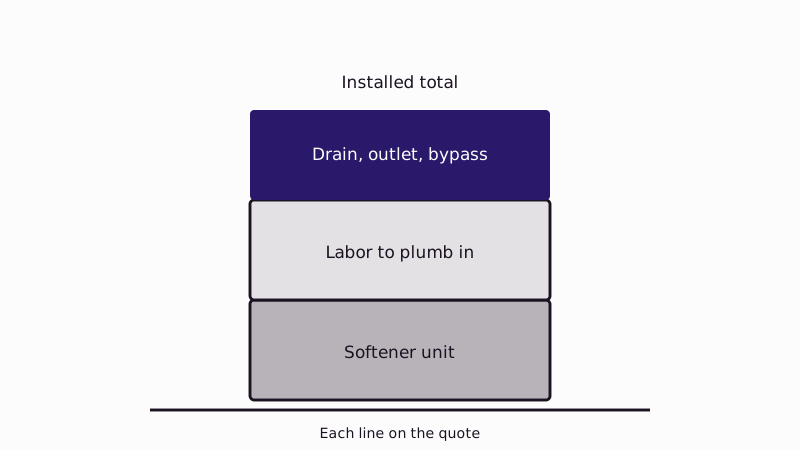
Budget somewhere between $1,100 and $3,000 for a typical installed water softener, according to Fixr, which reports a national average of $2,500 and extremes of $600 and $7,000. Your house gets its own figure only in a written quote, after someone has inspected the pipes. What follows splits the bill into unit, labor and extras. Undecided about buying? The water softener installation service page describes the work itself.
What is the typical bill for installing a softener?
Fixr's guide shows $1,100 to $3,000 for the installed job, with a $2,500 average. For the common ion-exchange softener alone, installed totals run $650 to $3,000. These are national guide figures, so a Westside quote can land above or below depending on access, pipe condition and the model chosen.
Think of the total as three buckets: the machine, the labor to plumb it in, and the odds and ends. Fixr lists ion-exchange units from $500 to $2,000, with labor between $150 and $1,000, which explains the spread in totals. Expect the cheap end when a garage has copper lines and a drain next to the spot. Expect the high end when the unit has to go indoors, through finished walls, or onto new electrical and drain runs.
How much does each softener type cost installed?
Ion-exchange units, the ones that use salt, run $650 to $3,000 installed per the Fixr guide. Salt-free conditioners and magnetic or electronic descalers are cheaper at $250 to $750, but they work differently and do not remove hardness minerals. Reverse osmosis systems run $2,400 to $3,100.
| Type | Installed total (Fixr guide) |
|---|---|
| Magnetic | $250 - $550 |
| Electronic | $250 - $750 |
| Descaler | $350 - $2,450 |
| Ion exchange | $650 - $3,000 |
| Distiller | $1,350 - $5,000 |
| Reverse osmosis | $2,400 - $3,100 |
Pick by goal, not by sticker. If the aim is to remove hardness at the tap and protect a water heater, the ion-exchange type is the category most people mean by "softener." A cheaper descaler may reduce scale buildup for some people but is not the same product, so ask any seller what exactly it does.
What does the size of the unit do to the price?
Capacity, measured in grains, raises the unit price. Fixr lists materials alone at $400 to $1,000 for 32,000 grains, $500 to $1,200 for 40,000, $600 to $1,500 for 48,000, and $1,000 up to $1,500 at 64,000, going up to $1,700 to $2,500 at 96,000.
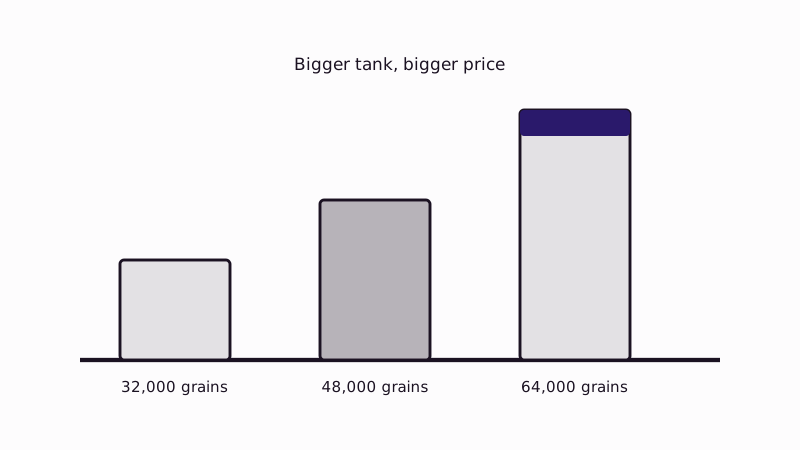
Larger tanks regenerate less often, which suits big households and very hard water, while a small household can easily overbuy. Have the installer size the machine from headcount and measured hardness instead of defaulting to the largest model. The extra grains cost money on day one and may not change daily life.
Is hard water in Santa Monica bad enough to justify the cost?
Santa Monica's tap water is moderately hard. Recent city water quality reports show an average near 161 ppm, roughly 9.4 grains per gallon, drawn from treated local groundwater blended with imported supply. Other Westside utilities publish their own figures, so read your supplier's report before spending.
Hardness at that level leaves scale on fixtures and inside the water heater, and plenty of households live with it happily. Buying a softener is more about comfort and upkeep than urgency. If you are weighing options, hard water and scale prevention explains other approaches, and a simple home hardness test strip costs little. Your supplier's annual report, found on its website or by request, is the best neutral number to read.
What do Kinetico, Culligan and other brands cost?
In the Fixr guide, Culligan and Kinetico units both span $500 to $5,000 for materials, RainSoft $1,700 to $2,500, Pelican $900 to $2,600 and Sterling $500 to $1,800. Installation comes on top. Rheem and AquaSure do not appear in that guide, so only a quote can price them.
Brand pages that quote prices usually bundle the unit, a dealer visit and sometimes a service plan, so compare like with like. Dealer-installed prices come as one number; plumber-installed prices split the unit from labor. Ask what the number covers: bypass valve, drain connection, the first bag of salt, removal of an old unit, and any labor warranty.
What about big-box store installs?
Fixr lists installed prices by retailer: Lowe's $1,000 to $2,800, The Home Depot $2,500 to $6,000 and Costco $4,000 to $6,000. Those include the unit and a contracted installer, and the plumbing often is not custom. Confirm who actually does the work and who is responsible if a leak follows.
Store installs are convenient and sometimes cheaper on promotion, but the installer you meet may be a subcontractor assigned to the job, and site-specific problems can lead to change orders. For fair comparisons, hand every bidder one description of the house: pipe material, the point of entry for the main, and the nearest drain.
What extras can push the price up?
A softener loop, which is a run of added pipe that keeps outdoor taps or irrigation on untreated water, adds labor. Other add-ons: fresh drain piping, an electrical outlet, a pressure regulator, shutoff valves, and repiping around corroded sections. Hard-to-reach locations add labor hours.
Pricing an install on older Westside houses often turns up surprises: galvanized pipe that crumbles when disturbed, crowded garage walls, and no outlet near the main. A good quote names each of those, or says plainly that they were not inspected. Ask whether a permit applies to your city, and read the paperwork before you pay.
Common questions
Can I work out the total with a calculator?
Do the sum yourself: unit price for your size, plus labor of $150 to $1,000 from the Fixr guide, plus extras named in the quote. A 40,000-grain ion-exchange machine, for example, starts at $500 to $1,200 before any labor. The plumber's written quote turns that estimate into a firm price.
Can I install it myself to save labor?
Some owners do, though the risks are leaks, drain mistakes and a voided warranty, and local rules on owner work and permits vary, so ask the building office first. For contractors the state sets a license requirement over $1,000 counting labor and parts, and deposits are held to 10 percent or $1,000, whichever is smaller.
Are softeners restricted in California?
Not statewide. State law lets a local agency limit or prohibit new residential softeners that discharge to a community sewer, if it makes specific findings by ordinance. A few areas outside this region have done so. Ask your city or sanitation district before you buy, and confirm what applies at your address.
What does ongoing use cost?
Salt, water and electricity, plus eventual repairs. The Fixr guide gives no single figure, and it shifts with hardness and household size. Ask the dealer how often the unit regenerates and how much salt it uses per cycle, then estimate a year of costs before choosing between models.
How is my own house priced?
Tell us about the layout and pipe type through the quote page; a written price comes back before the visit. The mechanics are explained in how softener installation works, hourly rates sit under plumber cost, and Sunset Coast Plumbing is the front door.
Sources used
Page updated