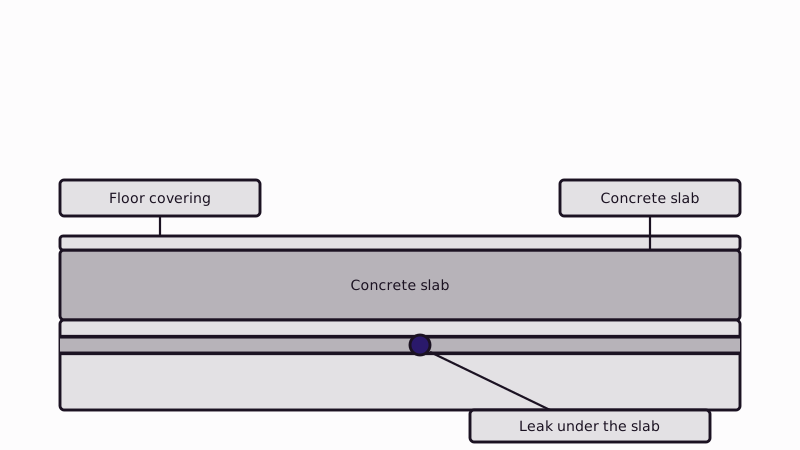
Fixr's slab leak guide puts the overall repair at $1,000 to $4,000, averaging $2,500, with $100 to $400 for pinpointing the leak. Read these as national planning ranges, never as a quote, because only a written estimate fits your house. Overhead reroutes and whole-house replacement run higher, and finished floors bring restoration costs. For the bigger picture on hidden water loss, see leaks and burst pipes. Each repair method below carries its own range and the reason for it.
What will a burst pipe or slab leak run me?
Fixr gives $1,000 to $4,000 overall for a slab leak, with a $2,500 average, and depth and floor covering move a job within that range. Locating the leak first is billed separately, $100 to $400 in the same guide. Abandoning the buried line for a new overhead route costs more, and replacing all lines costs more again.
| Method | Typical range (national guide figures) | When it fits |
|---|---|---|
| Leak detection | $100 to $400 (Fixr) | Always first, so you know where to open |
| Overall slab leak repair | $1,000 to $4,000 (Fixr) | One accessible break, sound pipe nearby |
| Reroute overhead | $4,000 to $15,000 (Fixr) | Repeated leaks or hard-to-reach location |
| Tunneling under the slab | $900 to $2,000 (Fixr) | Floors you would rather not cut |
| Pipe lining | $500 to $2,000 (Fixr) | Aging pipe, short access |
| Whole-house repipe | $1,500 to $15,000 (Bob Vila) | Pipe failing in several places |
When the burst is inside a wall and not under concrete, the plumbing piece is usually the smaller part of the bill, but drywall, paint or tile work follows. Have the pipe work and the patching quoted as two numbers.
Why do two slab leak quotes differ so much?
Price moves with three variables: the depth of the break, the route a crew has to take to reach it, and the finish overhead. Tile or hardwood must be lifted and matched, which costs extra. The pipe itself counts as well. Copper laid under mid-century Westside slabs often pits in places, so a spot fix now may be followed by another next year.
- Position: below a kitchen island is a harder dig than a hallway.
- Hot versus cold: copper hot lines wear out sooner.
- Permits: the building office can tell you whether the work needs one, and who applies.
- Hour of the call: after-hours dispatch carries a premium.
- Water damage: the drying, mold control and new flooring come on separate invoices.
Could this be a slab leak, and what comes first?
Clues include a hot spot on the tile, a faint hiss in a quiet house, a musty stretch of carpet by a baseboard, and a utility bill that keeps inching up. Test it by switching off every fixture, noting the meter reading, and looking again two hours later. A dial that has advanced means a leak somewhere. Shut the main and book detection.
The EPA describes that same two-hour meter check, then suggests dye in the toilet tank to eliminate the most frequent indoor leak. For what a detection visit involves, read about leak detection cost, and to pick who to call, see slab leak repair companies.
Which repair lasts longest on a leaking pipe?
Remove the failed length and splice new pipe in with new fittings. Clamps, sleeves, wraps and putty are temporary. What counts as permanent depends on the pipe: soldered or pressed joints for copper, solvent cement for PVC and CPVC, crimped or push-fit connectors for PEX. Where corrosion runs far, replace well beyond the spot that drips.
A gasketed clamp can hold for a few days until help arrives, but it is still a bandage. Water weeping at a threaded joint usually means a tired seal, not a split pipe, and a new fitting with fresh sealant ends it.
Is patching the pipe enough, or must it be replaced?
Frequently a patch will do. A pinhole, a small split or one bad joint can be repaired in place, and epoxy lining can extend a corroding line without tearing into walls. Pipe that keeps failing, or has worn thin everywhere, is cheaper to replace than to keep patching.
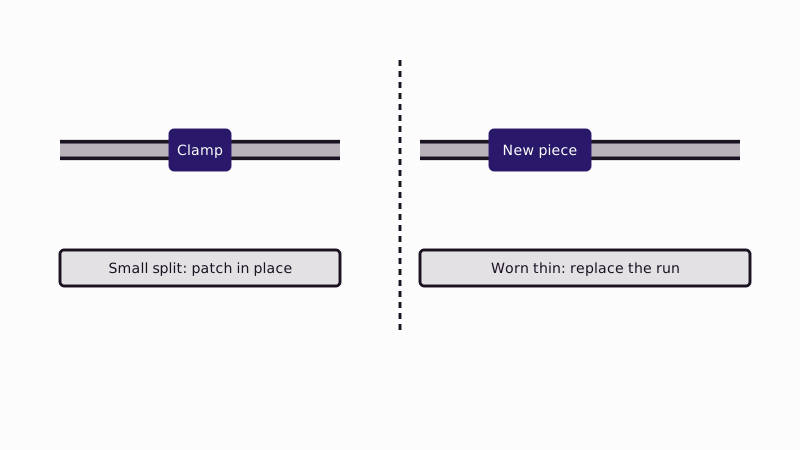
Repair makes sense where the neighboring pipe is healthy. Copper pinholes, a failed coupling, a cracked PVC elbow and a worn valve are all fixable. Several leaks inside twelve months raise a different matter: whether to repipe the house, weighed on the repair versus repipe page.
Does spray-on sealant such as Flex Seal fix a pipe leak?
No, not dependably. On a dry, low-pressure surface a coating or wrap might slow a drip, yet a live supply line forces water beneath the film and it lifts. Plenty of these products say on the label they are not for pressurized plumbing. Treat one as a stopgap for an afternoon at most.
Adhesion needs a shut valve and a dry pipe, so these products are no help while water is flowing. A repair coupling or a replaced section is the real answer and costs less than mopping up after a patch fails. Heating loops are a separate case: that water may be scalding, so isolate the line and have a contractor repair it.
Will my insurance cover a slab leak?
Resulting damage can be covered, but the pipe repair bill usually is not. Wording often hinges on whether the leak was an abrupt accident or a slow seep, and slab cases get murky because tear-out access may be treated apart from plumbing. Contact the insurer first, before any crew starts. There is more in slab leak insurance.
Take photographs, keep every invoice, and ask the plumber to record where the leak was and what caused it. Many slab jobs exceed $1,000, which triggers California's contractor license requirement and its cap on deposits.
Common questions
How disruptive is the job?
One-spot fixes can finish within a day, before flooring work. Rerouting commonly runs a day or two, tunneling two to four, and a whole-house repipe takes longer. Drying and finishing come afterward. A good quote splits plumbing days from restoration days.
Which questions belong in front of a quote?
Does the price include detection? Which repair method, and why that one? What becomes of the flooring? Will the building office require a permit, and who submits it? What is the license number, so you can look it up? Get the figures in writing with pipe work and restoration on separate lines.
Is there a slab leak cost calculator I can trust?
An online calculator produces a rough range without ever seeing your floor, so go easy on trusting it. Begin with the table above, then ask for a written estimate after detection. Depth, flooring and pipe condition set the final price, and only someone on site can judge those.
Will the water be off the whole time?
Mostly yes, because the main stays shut while the line is open. Count on several hours without water, and ask whether part of the house can be turned back on once the new section is in and curing, so showers are not lost for the whole day.
Prices are one part of the job: the plumber guide for Santa Monica covers the rest.
Sources used
Page updated