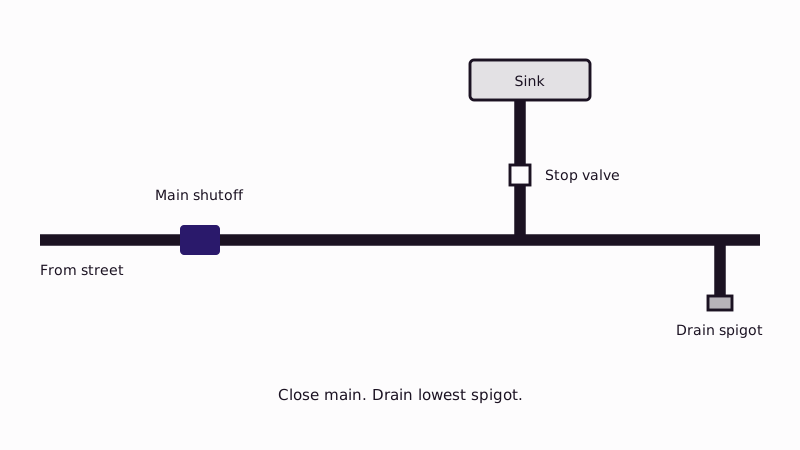
Many leaks are fixable without new pipe. If the failure is one joint, one pinhole or one loose nut, the plumber remakes that spot and leaves the rest alone. If the metal is thin for yards in each direction, patching only relocates the leak. Close the valve first and decide afterward. Photos and a description sent through the quote page let us line up a visit, and what follows sorts leaks by type.
Does every leaking pipe have to be replaced?
No. A weeping compression fitting, a bad solder joint or a single pinhole is a small repair: the bad inch gets sawn out, a coupling bridges the gap, and the line is pressure-tested. Replacement becomes the sensible choice when the pipe wall is pitted or flaking along its length, because the next leak is already forming.
Homes on the Westside show both patterns. In a 1950s ranch with copper that is otherwise sound, one repair usually holds for decades. In a 1920s Craftsman with galvanized steel, a leak is often the first of many, since rust works from the inside. Two pinholes in a single year on one run is a strong hint to price the whole run. The longer comparison lives in slab leak repair versus repiping, and copper specifics are in fixing a pinhole in copper.
What should happen in the first few minutes?
Find the nearest stop valve and turn it clockwise until it quits. At a sink or toilet that is the little oval handle on the supply tube. If the source is a mystery, shut the main and then drain the lines through the bottom-floor spigot. Next, protect the floor and photograph everything.
Keep clear of any water that has reached an outlet, a recessed light or the electrical panel. Throw the breaker only when your feet stay dry on the way to the panel. Wet drywall and wood floors both deteriorate faster than people expect: boards start to cup within days, and the EPA lists mold as a risk in damp materials. Pull rugs and cardboard boxes off the area and run a fan.
Will Flex Seal, wrap tape or epoxy hold a leaking pipe?
They can slow a drip, nothing more. Self-fusing tape and epoxy putty sometimes hold a pinhole on dry, depressurized copper. A rubber-sleeved clamp will often last days on a pinhole. Spray-on rubber on a wet, live pipe mostly just peels. None of these counts as a plumbing repair, and a plumber won't bless one.
The real danger is false comfort. A patched joint inside a stud bay can let go during a workday and do ten times the damage of the original drip. Use these products only as a bridge to the visit. Never put anything on a gas line: that is a job for the utility and a contractor. Our write-up of sealants and where they fail goes through the types.
How can you track down a leak you can't see?
Use the water meter as a witness. Stop every fixture, jot down the dial, go two hours without touching water, and look once more. Movement on the dial is the EPA's tell for a leak. Next drop food coloring into each toilet tank: color in the bowl after 10 minutes means a bad flapper. Those two tests split the problem in half before anyone opens a wall.
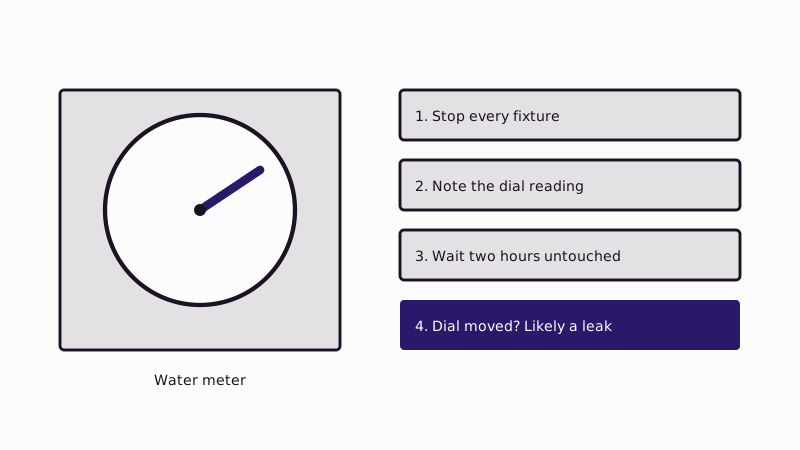
Beyond that, watch for a bill that crept up, a floor that feels warm, baseboards that smell like a damp basement, and a faint hiss at 2 a.m. The EPA puts average household losses past 9,300 gallons annually, with roughly nine percent of homes bleeding 50 gallons daily. If the tests point to a buried or enclosed line, a plumber narrows the spot with ground microphones, a heat camera and a pressure hold. Pricing for that step is in leak detection costs, and a surprise invoice is the subject of why the water bill jumped.
At what point is a leak an emergency visit?
When you can't stop it. A burst line the main valve doesn't tame, water raining through a ceiling, a tank that has split, anything touching electrics: those can't wait. A drip that stops when you close one small valve can sit until a normal weekday slot, which usually costs less.
The office works weekdays, nine to five. When a leak starts at night, close the main, record the damage, and submit your request so it is waiting that morning. For fast-moving situations, the burst pipe emergency page lays out what to expect, and telling a burst from a leaking fitting helps you describe it accurately.
Slab, wall or ceiling: does the location change the repair?
Entirely. Under a concrete slab, the options are jackhammering to reach the pipe, tunneling beneath it, or retiring the buried line and routing a new one overhead. In a wall, it's a neat opening, a new section and a patch. A ceiling stain means tracing uphill, and the culprit is often the bathroom or kitchen above.
Water travels along joists and pipes, so the spot where it drips is not where it starts. Slabs are typical for Venice, Marina del Rey and much of Santa Monica's newer construction; raised-foundation Spanish Revival homes in Brentwood and Culver City hide their lines in crawl spaces and wall cavities. Specifics for ceiling leaks and what a slab repair costs are on their own pages.
Which costs does insurance take on, and what about renters?
Homeowner policies usually answer for sudden discharge, the burst that floods a kitchen overnight. They usually decline months of slow seepage, and the worn pipe itself. Wording differs between carriers, so check the water section and call your agent before demolition starts, and keep each receipt.
California puts the duty to maintain plumbing on landlords (Civil Code 1941.1), so a failing supply line in a rental wall is the owner's repair. A tenant's furniture and clothing fall under a renter's policy instead, and a tenant whose overflowing tub caused the damage may be liable. Report in writing on day one. More detail: burst pipe claims and slab leak coverage.
What happens during the repair, and what does California require?
The visit goes in a fixed order: confirm the source, isolate and drain the section, cut out and replace the failed piece, refill, then watch the fixture under pressure for drips. A price in writing comes before a pipe gets cut, shaped by material, access, and how much finish work follows.
Two California rules worth knowing. Work worth $1,000 or more, parts and labor combined, requires a California contractor license. Any deposit stays under $1,000 and under a tenth of the price. New pipe runs typically need a city permit; the plumber files it. To avoid a repeat, read about what makes pipes split and winterizing and prevention habits. Browse the rest of the services from the Sunset Coast Plumbing home page.
Common questions
Smell gas near a leak: who gets the call?
Walk out first. Once outside, the utility's emergency line is 1-800-427-2200 (SoCalGas), with 911 for real danger. Switches, lighters and the car keys can wait until you're well away. Gas is a different animal from water: you don't patch it, and the utility checks the line before anyone goes back in.
Is a burst pipe repair pricey?
Rarely is the pipe the big number. A reachable fitting is cheap labor; a burst behind tile or under a slab brings demolition, patching and drying. Spreading water is what inflates bills, which makes the main valve your cheapest insurance. Line items arrive in writing first.
What should you avoid telling an insurer?
Skip speculation. Say what you saw, when you saw it and what you did. Don't state a cause you haven't confirmed, don't say it had been dripping a while unless you know, and don't accept a settlement before the damage is fully scoped. Keep the failed pipe section and dated photos.
If I rent and a pipe bursts, am I on the hook?
For the pipe, normally no. The owner must keep plumbing working. You're responsible for insuring your own belongings and for damage you cause through misuse, such as leaving a tub running. Send the landlord a written note right away, with photos, so the date of discovery is on record.
Could a pipe fail and nobody notices?
Yes, for weeks. A pinhole or a split inside a wall, crawl space or slab doesn't announce itself. Look for a creeping bill, a dial that spins when everything is off, a musty room or a warm patch of floor. Try the meter check described earlier and attach the readings to your request.
More in this guide
- Burst water pipe in the house
A burst pipe in the house: shut the water, protect electrics, call a plumber and document damage.
- Ceiling water leak
Water coming through a ceiling? Shut off the water and the power to that area, find the source, protect the room, and learn what repair…
- Leaks and burst pipes
Homeowners policies usually cover sudden water damage from a slab leak but not the pipe fix itself.
- Leaks and burst pipes
A burst pipe is usually treated as sudden and accidental damage, a slow leak is not.
- Pinhole leak in copper pipe
Stop a pinhole leak in copper pipe: shutoff, temporary patches, a lasting repair, what to do about wet ceilings and walls, and when…
- Leaking pvc pipe joint
A leaking PVC joint is a drain, a threaded fitting or a glued supply joint, each with its own fix.
- Leaks and burst pipes
How a leaking water pipe is repaired depending on whether it is copper, PEX, galvanized, CPVC or PVC, what you can do yourself, and what…
- Leak detection cost
Leak detection is billed apart from the repair.
- Slab leak companies
Picking a slab leak company in Santa Monica: license checks, detection method, written scope, permits and the sales pitches that should…
- Pipe leak sealant
Epoxy putty, repair tape and clamps can slow a pipe leak for a while.
- Leaks and burst pipes
Ceiling stains with no drip can come from old leaks, condensation, roof or AC drain trouble.
- Burst pipe prevention
Most burst pipes give warnings first. A pressure check, a shutoff you can find, and a yearly walk-through can head off a flood in Santa…
- Burst pipe emergencies
Burst pipe in Santa Monica or the Westside?
- Leaks and burst pipes
Seven signs a pipe has burst in a Santa Monica home, a meter test that settles it, what to do in the first ten minutes, and when to call a…
- Costs
Slab leak and burst pipe repair costs in 2026: spot repair, reroute, tunneling and lining ranges from a published guide, detection fees…
- Slab leak: repair or repipe
Fixing one slab leak or replacing the whole supply system?
- Leaks and burst pipes
Pipes burst from pressure spikes, corrosion, ground movement and, rarely here, frost.
Sources used
Page updated