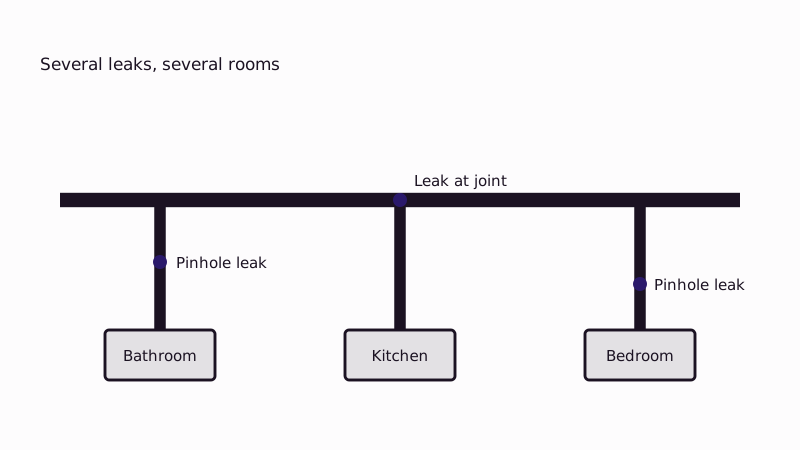
Pinhole after pinhole, tea-colored water at dawn, a shower that dribbles no matter how many parts you replace: a house in that state is asking for new supply pipe instead of another patch. Repiping is big work because it opens walls, so the decision deserves a clear head. What follows separates a dying system from bad luck, matches material to a Westside house, explains the city side and decodes the price. Everything else we arrange sits on the Sunset Coast Plumbing home page; a priced visit begins with the quote form.
What tells you the whole system is failing, not one joint?
If leaks surface in separate rooms, every tap runs cloudy, and pressure sags after each fix, the pipe itself is the culprit, not one joint. A lone leak in healthy copper is no reason to repipe, but a pattern spread across the house is.
Keep a log for a week or two. Write down where each leak appeared and when, what the water looks like on first draw after sitting overnight, and which taps run weak. Handing that log to the plumber saves a lot of guessing. When a slab or wall leak is the trigger, the slab leak versus repipe decision guide shows where a single fix stops making sense, and the page on how often a house needs new pipes takes the age angle.
Three kinds of Westside house come up again and again. Craftsman and Spanish Revival homes from the 1920s and 1930s, common in Santa Monica and Culver City, were plumbed in galvanized steel that scales over the decades. Mid-century ranch houses often hold copper that is sound overall but pitted in spots. Tract houses from the late 1970s can hide polybutylene, the plastic sold as Poly-B. Per Wikipedia, it was put into millions of North American houses before the late 1990s.
Why do galvanized steel and polybutylene give out?
Galvanized steel corrodes from within until rust narrows the bore and strangles the flow. Polybutylene fails another way. Disinfectant chemistry in tap water eats at the plastic and its fittings, mostly where it bends or connects, and nothing shows from outside until a drip or split.
On polybutylene, the reference article states flatly that the lasting remedy is replacing the plumbing throughout the building. That fits what tradespeople report: patch one run and another lets go later. Galvanized steel allows partial work, since a damaged section can be swapped, but when the whole system is scaled up the pressure complaint simply returns.
Each material has its own guide, replacing galvanized pipe and replacing polybutylene. Either way, a plumber should look before anything is ordered.
Should the new lines be PEX or copper?
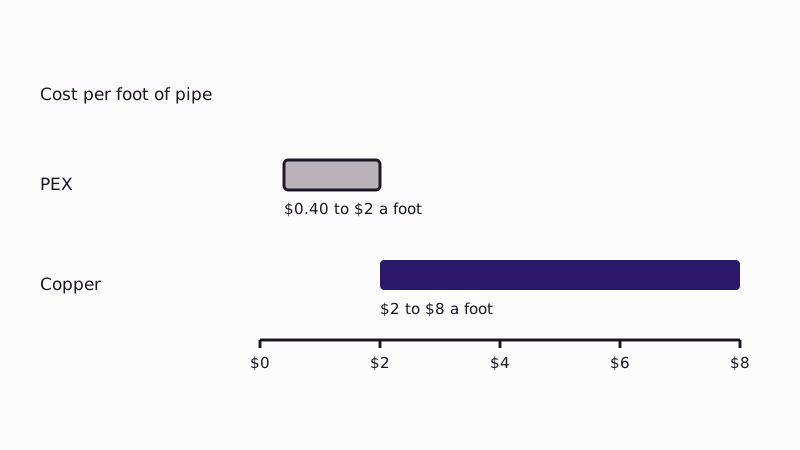
Either one is a sound choice. In Bob Vila's figures, PEX runs forty cents to two dollars a linear foot and lasts 80 to 100 years, while copper runs two to eight dollars a foot and lasts 50 to 100. PEX bends through framing with fewer cuts. Copper is pricier on both materials and labor.
California's plumbing code allows PEX, with conditions on how it is installed, so ask which code rules your plumber is following. Sunlight is PEX's enemy, since manufacturers limit how long it may sit in direct light. A hillside house with an exposed run along a sunny wall needs a plan for that.
Salt air near the beach is rough on bare copper and brass in exposed spots, so ask where each fitting will sit and what material the plumber proposes there. The PEX against copper comparison takes the choice further.
What will a full repipe set me back?
Bob Vila's national guide runs from $1,500 to $15,000, averaging $7,500. Its figure for a compact three-bedroom (1,500 square feet) is $2,280 up to $5,120. Wall repair is extra. Think of those as a guide, with the written quote prepared for your address as the only real number.
| Line item | Guide figure |
|---|---|
| Entire house, national spread | $1,500 to $15,000 |
| PEX pipe | $0.40 to $2 a foot |
| Copper pipe | $2 to $8 a foot |
| Labor for roughly 15 hours | $675 to $3,000 |
| Permit | $50 to $500 |
| Drywall repair | $50 to $75 a square foot |
The walls move the total more than the pipe does. Finished plaster upstairs and down means far more cutting and patching than a single story with a roomy attic. The repipe cost page digs into what pushes a quote toward the top or the bottom of the range.
How long is the house without water?
None of the sources behind this page gives a whole-house schedule, only a labor estimate near 15 hours, so a real timeline has to come from the written quote. Plan on the taps being dry for part of each work day, and have the plumber name those days.
Before signing, settle three things. On which days is the water off, and from what hour to what hour? Who patches and paints the walls, and when? How will dust be kept out of the rest of the house? A home with a newborn, a home office or someone on medical equipment may prefer the job done in stages.
Line up somewhere to cook and wash on the heavy days. A relative's kitchen costs less than a motel for a short outage.
Does Santa Monica require a permit to repipe?
Yes, the city lists re-piping among the jobs covered by its Single Trade Construction Permit, which includes up to three inspection visits. Houses in Brentwood, Westwood or Venice fall under the City of Los Angeles instead, so the building office differs by address. Your contract should say who applies for the permit.
Your contract should name who pulls the permit and spell out a payment schedule, a finish date and a cleanup plan. On deposits, the state caps what a contractor may ask up front: a tenth of the price, never more than $1,000. A contractor license is needed once the job reaches $1,000, and the license number appears on the contract. A repipe clears that bar by a mile.
Repiping is not a weekend DIY job. A sloppy joint inside a closed wall can seep for months. If gas is ever smelled during construction, everyone goes outside and SoCalGas gets the call from there, at 1-800-427-2200.
When is repiping worth it, and when should you just patch?
It pays off when leaks keep returning, when the pipe is a known problem material such as polybutylene, or when walls are open for a remodel anyway. It does not pay off for one stray leak in healthy copper, where a local repair is quicker and cheaper.
A fair test: total what patches and water damage have cost in recent years and set that next to the repipe quote. Ask for both options on paper, and distrust a spoken "it will probably hold." After a sudden burst, an insurance claim may be possible, so read the policy or phone the insurer before any work begins. This page does not promise coverage.
Common questions
Can a handy owner take this on?
Not in any sensible way. Permits, inspections, pressure tests and joints sealed behind drywall rule it out. State law also sets a $1,000 ceiling on work without a contractor license. Clearing access and moving furniture is your part; the pipework goes to whoever holds the matching state classification.
Which choices lower the price?
Savings come mostly from PEX in a house with easy access and few finished walls. Plaster, tile and cramped crawl spaces push the figure up. Ask for a full repipe and a staged plan that fixes the worst run first, then compare both against what you have spent on patches.
Will it wreck my walls?
Walls do get openings, because pipe has to be pulled through framing. Bob Vila's guide puts drywall repair at $50 to $75 a square foot. Check whether the quote includes patching, texture and paint, or only plumbing, because contractors split the work differently.
What about a smaller three-bedroom?
In Bob Vila's guide, pipe work alone for a three-bedroom of that size runs $2,280 to $5,120; walls and fixtures are billed apart. A two-story or finished-plaster home usually lands higher. Your written quote, produced after the plumber checks access, is the figure that counts.
Is moving out necessary during the work?
Normally no, though there will be noise, dust and stretches without water. Ask for the water-off schedule and plan where to cook and wash. If anyone at home needs running water for health reasons, say so before the quote so the plan can be staged.
Pipes of unknown age? Describe them through the quote page and a visit nearby gets scheduled. For the on-site sequence, read the guide to repiping with PEX, and for the argument behind the decision, see why people repipe.
More in this guide
- Repiping and pipe replacement
Galvanized pipe replacement costs: the HomeGuide national range, PEX versus copper, what pushes a quote up, and what the written estimate…
- Repiping and pipe replacement
Replacing galvanized steel supply pipe on the Westside: warning signs, PEX versus copper, how many days it takes, permits, and what about…
- Polybutylene pipe replacement
Spot polybutylene pipe, understand why it fails and learn what replacing it with PEX or copper involves for a Santa Monica or Westside home.
- Repiping and pipe replacement
No pipe has a fixed repipe date. See the signs that matter for galvanized, copper and PEX in Southern California homes, and when a repipe…
- Repiping and pipe replacement
How a whole-house repipe runs, from shutoff to patched drywall: PEX or copper, slab homes, permits and what to put in a written quote on…
- PEX vs copper
PEX or copper for a Westside repipe: cost, flow, lifespan, coastal and hillside factors, and which suits an older Santa Monica or…
- Repipe cost
What repiping a Santa Monica or Westside house costs in 2026: ranges by house size and pipe material, what moves the price, and how to cut…
- Why repipe
Why Westside owners repipe: pinhole leaks, rusty water, weak pressure, polybutylene and old galvanized lines.
Sources used
Page updated