A repipe retires the old supply lines in your walls and replaces them, normally with PEX or copper, then reconnects each fixture and closes the walls. Expect a few working days, with the main valve closed for chunks of the workday. It is plumbing contractor work, a C-36 classification in California, and not a project for a homeowner. The repiping overview covers when the job makes sense; browse everything else we line up from the home page.
What does a repipe look like from the first morning to the last?
The first morning is about protection: floors covered, the main valve shut, the first access holes cut. After that the plumber pulls new lines out to each fixture, gathers them at a manifold or trunk line, and pressure-tests the lot before any wall is closed. Patching and paint come last. Ask which hours the water will be off, because that varies by house.
A typical sequence:
- Walk-through and quote, with the plumber marking every fixture and the likely access points.
- Permit pulled before work starts.
- Water off, old lines disconnected, new lines pulled or fed through the framing.
- Pressure test, then a city inspection where the permit calls for one.
- Drywall repair and cleaning.
Whether patching sits inside the price is a question for the quote, since finish carpentry and paint are sometimes a separate trade.
Which is better for my home, PEX or copper?
California's plumbing code accepts both. PEX bends, needs fewer joints and slides through finished walls with smaller openings. Copper is rigid, takes more labor, and has a long record in older Westside houses. Neither wins everywhere: the house, the water and your budget tip it.
Some specifics worth knowing. PEX was added to the California Plumbing Code in 2009, with conditions that include sleeving underground runs, using fittings that resist dezincification, and flushing the system after filling. PEX also should not sit in direct sunlight: one reference warns that a month of exposure can shorten its life, so any run in a garage or open crawl space needs covering. Copper does not mind sunlight, but it can pit in some water chemistries, and soldering needs fire care around old framing.
For a deeper comparison, see PEX versus copper.
What does PEX repiping involve step by step?
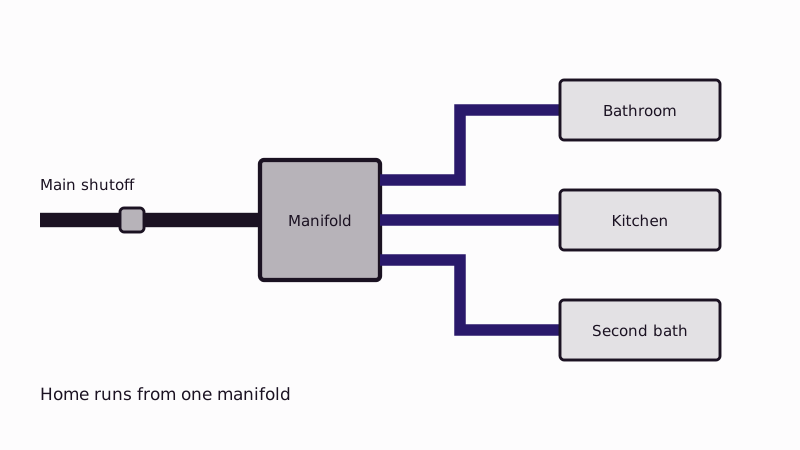
The old line comes out, and flexible tubing goes in, either fanned from one manifold or branched off a trunk, joined by crimp rings or expansion fittings. No soldering is involved. Since the tube curves, many runs travel through existing wall cavities, so access holes stay small.
A manifold gives each bathroom and the kitchen its own shutoff, so one room can be isolated without losing the house. A trunk with branches uses less tubing but fewer valves. Ask which one the quote assumes, and where the manifold will live, because it must stay reachable.
What about repiping with copper?
Copper goes in as rigid tube cut to length, joined by soldered fittings or by press fittings that need no flame. It is slower, and wall openings run larger because the tube cannot curl around a stud. It suits houses with sound original copper where matching matters, or spots where PEX is a poor fit.
Press fittings are a middle path: they avoid torch work in tight old framing. Either way the plumber should say what grade of copper is used and how the new line is isolated from any remaining galvanized steel to limit galvanic corrosion.
How is a house on a slab repiped?
With no crawl space under a slab house, plumbers pick between two paths. One abandons the lines in the concrete and routes replacements above, via the attic, then drops them behind the drywall. Option two is to break the slab open and swaps pipe where it lies. Rerouting avoids jackhammers but asks for more drywall access.
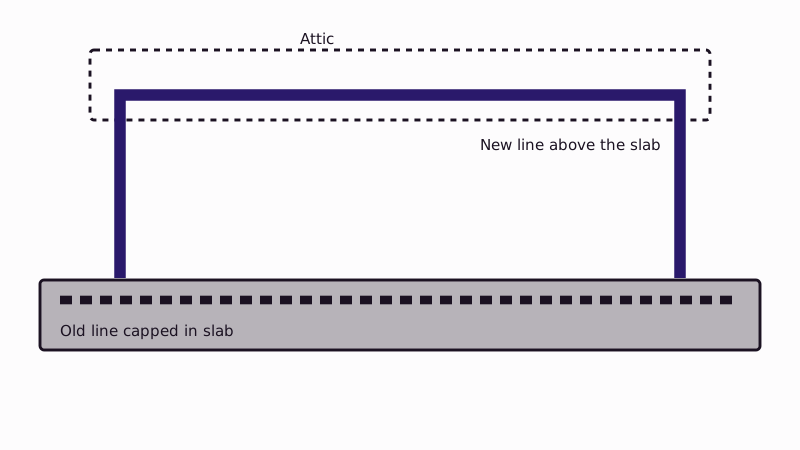
Which path fits depends on where the leak or corrosion sits. A single slab leak may only need a spot fix, while several failing lines may lead a plumber to quote a reroute. Slab leak repair or repipe walks through that decision.
Which permit does a repipe need, and whose job is it?
Expect a permit, and expect the work to need a contractor: a repipe blows past the $1,000 mark, labor plus materials, where California begins requiring a contractor's license. Look up whoever quotes you on the CSLB site. Your city's building office can say what its permit rules require for your scope.
Pin down the permit applicant and whether the inspection fee is in the price. Deposits on home improvement work stop at one tenth of the price or $1,000, the lower figure. A request for more, or a suggestion to skip the permit, is a reason to walk away.
How do I know the old pipes need replacing in the first place?
Repeated pinholes, brown water, pressure sagging across the house, and notorious materials such as galvanized steel or polybutylene are the usual triggers. A lone leak does not justify a repipe, but a pattern across rooms often does, and EPA's household average runs past 9,300 gallons of leakage annually.
Companion reading: the replacement interval, the case for repiping and the repipe cost guide. Rusty steel lines have their own page, galvanized pipe replacement.
What should a repipe quote spell out?
Look for the pipe type (PEX or copper, with the grade), the fixtures covered, the access holes and who patches them, the permit and inspection, the water-off schedule, and how surprises behind the wall are handled. A figure with none of those details cannot be compared with another bid.
Also ask whether the water heater connections, shutoff valves and a pressure regulator are touched. Old shutoffs that stay behind a new line are a common weak point, and swapping them while the walls are open costs little extra effort.
Common questions
How long are the taps dry during a repipe?
Not for days on end, as a rule, but in blocks. The plumber should name the shutoff windows in advance. A big house with many bathrooms stretches the job, so line up showers and a toilet elsewhere for the hardest stretches, and ask when water returns each day.
Is a repipe a DIY job?
No. Licensing starts at $1,000 and a repipe lands far past it, with permit and pressure-test steps on top, plus the risk of a flooded wall if a joint is wrong. Most owners hire a plumbing contractor and start with a written scope from the quote page.
Are the walls patched when the plumber leaves?
That depends on the quote. Some plumbers patch the access holes and some leave them rough for a drywall trade. Get the answer written down before work starts, paint matching included, so the last day holds no surprises for you.
Sources used
Page updated