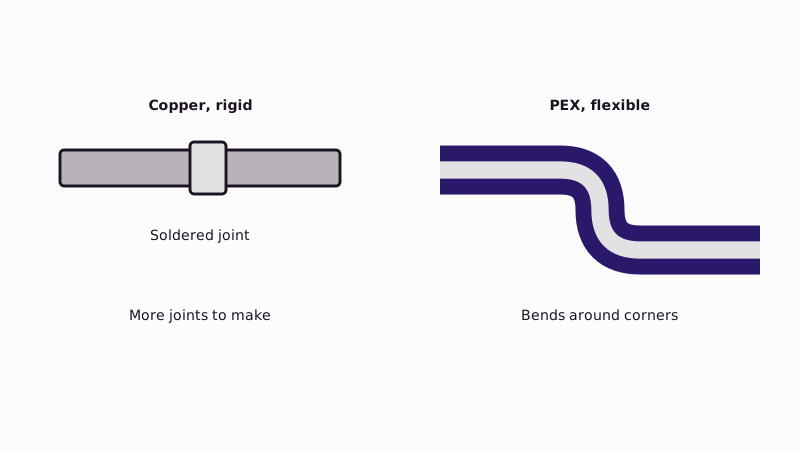
For a typical Santa Monica house, PEX usually costs about half as much to install as copper and goes in faster, with fewer holes cut in plaster. Copper costs more but tolerates sunlight, high heat and years of use. Both are accepted for residential repiping in California, subject to city rules. The choice below depends on budget, wall access and what your water does to metal. Cost and scope for the whole job are on the repipe house page.
Which material suits a Westside house better, PEX or copper?
PEX suits most whole-house repipes on a budget, mainly because flexible tubing snakes through walls with far fewer cuts, fittings and patched drywall. Copper suits exposed runs, hot-water recirculation lines and owners who want the material with the longest record. Neither is wrong; the walls and the water decide.
Think about where the pipe goes. In a 1920s Craftsman or Spanish Revival in Santa Monica or Venice, with plaster and lath walls, every opening is a repair bill, so PEX's long continuous runs save money. In a hillside house in Brentwood or Malibu with exposed garage or crawlspace runs, sun, rodents and slope movement favor protected or metal piping.
What is the price gap between the two?
Published guides show PEX for a 1,500 square foot home around $4,000 to $11,000 against copper at about $8,000 to $22,000, and Los Angeles pricing may sit toward the upper end. Per linear foot, Angi shows about $0.40 to $2 for PEX and $2 to $8 for copper in materials.
Labor is most of either bill. Soldering every joint makes copper slower. Drywall repair, permit fees and any water damage found behind walls sit on top, so read these as a guide while the plumber's quote carries the real figure. For a full breakdown by house size, see repipe cost.
Which lasts longer, copper or PEX?
Copper has the longer proven record, often 50 years or more when the water is gentle, but it can pit and pinhole much sooner in aggressive water. PEX makers commonly cite 40 to 50 years indoors, with fewer decades of field data behind that figure. Neither number is a promise: water chemistry, pressure and installation quality drive the real result.
Pinhole leaks are the usual reason Los Angeles homeowners leave copper. They start from the inside, where water erodes the wall over time, and once one appears others tend to follow. PEX avoids that failure mode but dislikes sunlight, so it must stay covered, and prolonged very hot water or heavy chlorine shortens its life.
Does the pipe size change the flow?
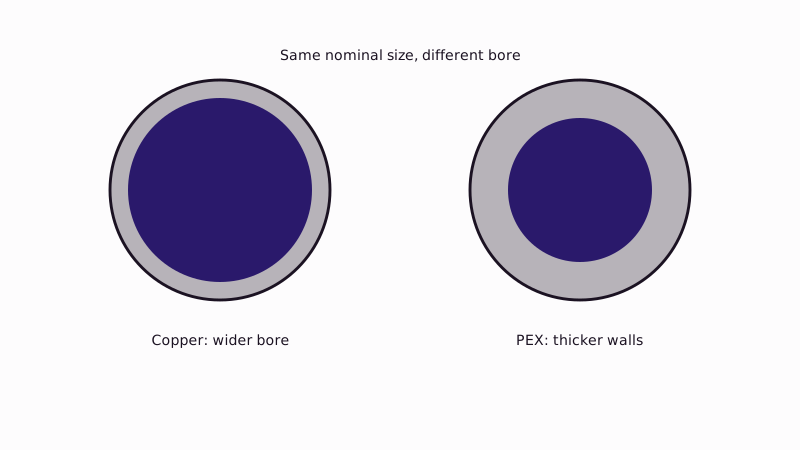
Half-inch PEX moves a little less water than half-inch copper, because PEX walls are thicker and its fittings narrow the bore. In practice plumbers upsize one step or use manifolds with home runs, and most households never notice. Whole-house flow depends more on the service line, the regulator and street pressure than on tubing material.
If the house already struggles with weak showers, address the cause first: a clogged galvanized main, a failing regulator or an undersized service line. A guide to the usual suspects is why water pressure runs low.
Where does PVC fit in?
PVC is cold-water-only and mainly used outdoors or for drains, so it is not a competitor for hot and cold house lines. CPVC handles hot water but turns brittle with age and is less common in new California repipes. For indoor supply lines the practical contest is PEX against copper.
Sunlight and impact break both PVC and PEX, which is why exposed runs near a hillside garage or an outdoor shower often stay copper while the wall runs change to PEX. Mixed systems are normal and allowed when joined with proper transition fittings.
Does cold weather matter in Santa Monica?
Barely. PEX flexes when water freezes, and copper can split, but frost is rare on the coast and only a few canyon and higher-elevation spots see it. Heat and salt air matter more here, so exposed copper near the ocean can tarnish and corrode, while PEX hidden behind walls is shielded from both.
Where cold does matter, an insulated sleeve over any exposed run costs little. For most Westside homes the climate argument is a tie, so decide on cost, access and lifespan rather than frost.
Common questions
Is PEX allowed for repiping in California?
Yes. PEX is accepted in the California Plumbing Code for residential supply lines, and cities issue permits for PEX repipes routinely. Individual cities can add requirements, so the plumber confirms details with the local building department. Never let anyone repipe without a permit, because the inspector is the one who witnesses the pressure test.
Will PEX change how my water tastes?
A new PEX system can leave a faint plastic taste or smell for the first few weeks. Flushing every tap and running water through the system for a few days typically clears it. Copper does not do this. If the taste persists, raise it with the plumber, who can check how the lines were flushed.
Is a mixed PEX and copper system acceptable?
Yes. Many repipes run PEX through the walls and keep copper where pipe is exposed, beside the heater or at fixture stubs. Proper transition fittings join them. Mixing metals with certain steel fittings can corrode joints, so the plumber chooses brass or approved fittings at every dissimilar connection.
Is it cheaper to repipe part of the house?
Sometimes. Replacing a single failing branch, such as the kitchen and one bath, costs less up front than a whole-house job, though leaves older pipe behind that may fail next. If pinholes have appeared in more than one place, a full repipe often proves cheaper overall than serial repairs and wall patching.
How do I request a quote for PEX or copper?
Use the quote page and note the house age, size, the current pipe material, and whether you want PEX, copper or advice. Expect a price on paper before any work begins. A contractor license is required in California from $1,000 of work, and the state board offers a license lookup.
More services are listed on plumber in Santa Monica.
Sources used
Page updated