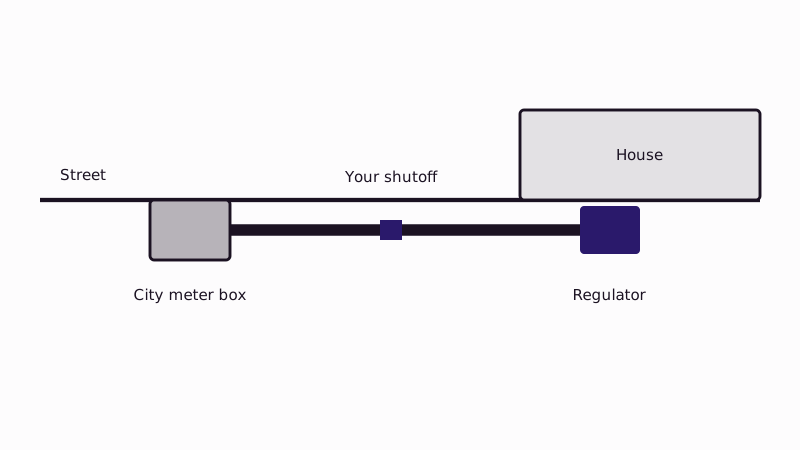
Follow the water. The city's meter sits in a concrete box below grade, usually in the parkway by the curb or in the alley behind the house. From there a line runs to your property, past a shutoff valve on your side of the lot, and into the building. The regulator is normally on that line shortly after it enters, near the main shutoff. Pressure trouble in general is covered under low water pressure, and the quote form lines up a plumber when the valve stays hidden.
How do I find the regulator in my house?
Stand at the spot where the main pipe pierces the wall or floor and look a few feet along it. The regulator is the brass fitting that resembles a bell, topped by an adjusting screw and locknut, and it usually sits close to the main shutoff. Likely spots: a garage wall, a utility closet, a crawlspace opening or a box at ground level.
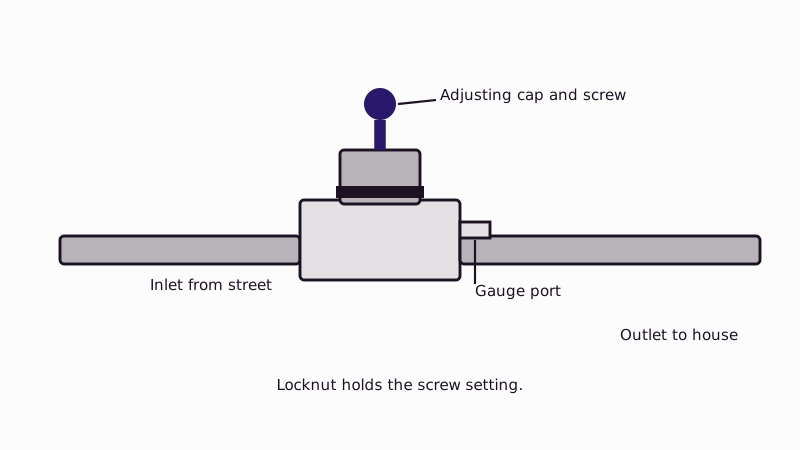
Trace the pipe, not the room. If the main enters through the garage, look along that wall at about waist or chest height, behind the water heater or beside the shutoff. In older homes the line may come up through the foundation under the house, so check the crawlspace access. An arrow stamped on the body shows flow direction, and it points toward the house, not the street. If the fitting is a plain straight valve with a handle, it is a shutoff, not a regulator.
Where are the meter and shutoff in Santa Monica?
The city's page says the meter is generally in the parkway near the curb or in the alley behind the home, below grade in a concrete box. Every property is required by code to have its own shutoff valve, usually on the side of the building near a hose bib, irrigation or pool controls.
Two valves, two owners. The valve inside the meter box is the city's, and only city personnel may operate it. The one on your property is yours. The pressure regulator belongs to the house side, downstream of your shutoff, so it is your equipment to test and replace. If you cannot find a property shutoff, the city's Water Resources Division at 310-458-8531 can advise, and it may charge for a city shutoff unless a new valve is installed.
What if I cannot find one?
Many older houses have none. The average pressure from a Santa Monica meter is about 70 psi according to the city's own irrigation guide, which sits below the 80 psi level where California plumbing guidance expects a regulator, so a house can legitimately run without one. A gauge settles the question.
Readings differ from street to street, though. Hillside lots in Brentwood and Malibu can see far higher readings, and a house on a low street near a main can too. Screw a hose-thread gauge onto an outdoor faucet and read it while nothing else runs. A steady reading above 80 psi suggests you need one, and a plumber can fit it. See the pressure regulator installation cost page for price factors.
How do I know the regulator is the problem?
Signs include a reading well above the target on a gauge, banging pipes, dripping faucets, toilets that keep running, a relief valve that weeps on the water heater, and pressure that creeps up after months. Low pressure can come from the regulator too, if it has failed closed or clogged.
The old brass valves wear. A diaphragm hardens, the seat gets debris, and the output creeps. When you see a high gauge reading with the adjusting screw set low, replacement is more likely to help than more tweaking. Setting a working valve is the subject of adjusting the regulator, and replacement choices are in whole-house regulators.
What if I live in a condo?
In a building with many units, one regulator may serve everyone or a single floor, and it can sit in a mechanical room, a riser closet or a garage rather than inside your unit. You usually cannot adjust it, and the association or landlord is responsible, so report symptoms in writing.
If your unit has its own valve, it is typically in the utility closet near the water heater. Ask the property manager for the plumbing plan, which shows risers and shutoffs. Plumbers can also trace lines with a pressure test at a washing machine hookup or an outdoor tap. Never close a shared valve without telling the building.
Does the water heater come before or after it?
The regulator comes first. It sits on the cold supply upstream of the heater and the branches, so everything inside the house gets the same limited pressure. If you have a hot-only regulator, that is unusual and worth asking about. See hot water pressure regulator for how the pieces fit.
If you have a regulator and a closed system, an expansion tank near the heater absorbs the pressure rise when water heats, and a worn tank can mimic a regulator fault. A plumber checks both. Heaters generally are covered under water heater service.
Common questions
How can I recognize one by sight?
A brass body with a bell shape, a screw or bolt on the cap, a locknut, and sometimes a small gauge port, roughly fist-sized, with the pipe passing straight through. A plain valve with a lever or wheel handle is a shutoff and not a regulator.
Can a regulator be outside the house?
Yes. Some are installed in an in-ground box near the property line or on an outside wall, especially where the main enters the lot. Look for a lid labeled water or a box near the shutoff, and check with a plumber before opening anything buried.
How can I read my own pressure?
Screw a gauge made for hose threads onto an outdoor faucet, stop other water use and open the faucet fully, then read the dial. California plumbing guidance puts the upper limit at 80 psi. If you read higher, ask a plumber to test the regulator.
Who is responsible for the regulator?
You, as owner, because it sits past the property shutoff on your side. The city responds to its meter and its own valve, and not the house plumbing. In a condo, ask the association which regulator serves your unit and who maintains it.
The rest of our guides start from Sunset Coast Plumbing plumber.
Sources used
- City of Santa Monica Public Works, Your Water Meter, location of meter and property shutoff valve
- City of Santa Monica, Cash for Grass guide, average meter pressure and regulators
- Published California plumbing guidance on regulator placement and the 80 psi limit, secondary sources, checked November 2026
Page updated