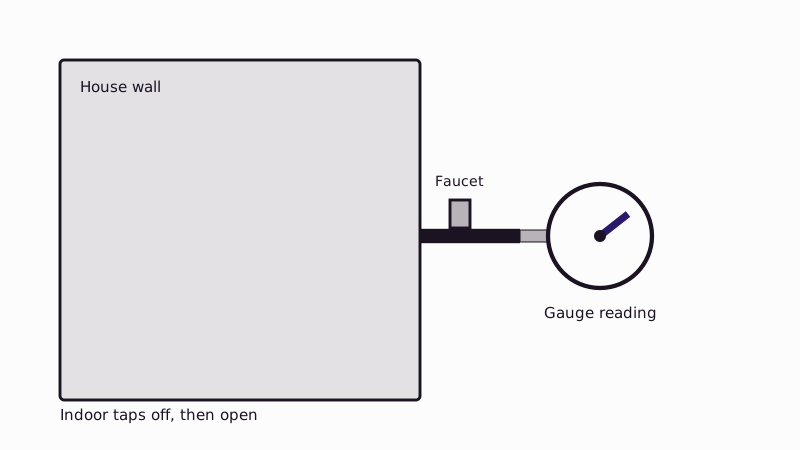
Start with a number. Attach a pressure gauge to a spigot outdoors, confirm that nothing indoors is drawing water, and note what the dial shows. That number tells you whether the supply is weak or the plumbing is restricting it. The state plumbing code demands a regulator when pressure goes beyond 80 psi, which marks the upper limit. Then work down the list below, cheapest fix first. The overview is on the water pressure and valves page.
The order matters. Most weak-pressure complaints end at step two or three, and a booster pump, the costly answer, is usually the wrong first move.
Step 1: What does a gauge say your pressure really is?
Thread a gauge made for hose bibs onto an exterior faucet with the house water off at every fixture, open the bib, and read the needle. That is static pressure. Then open a tap or two and watch the needle sag. A small drop is normal. A big drop means flow restriction, not a weak supply.
A hardware store sells a basic gauge for a few dollars. Take the reading morning and evening, since street pressure varies across the day. If static pressure is healthy and the flow collapses when a tap opens, the problem is a clog, a half-closed valve or narrow pipe. If static pressure itself is low, look at the meter valve, the regulator and the street supply.
Step 2: Are the valves fully open?
Two valves feed the house: the utility's valve at the meter and your main valve at the house. A partly closed one chokes everything beyond it. Open both fully and recheck the gauge. Then check the stop valves under fixtures that run weak.
Gate valves, which have round handles, wear out internally, so a valve that spins without resistance may need replacement. Do not force it. A plumber can replace a gate valve with a full-port ball valve, which does not clog the same way.
Step 3: Which fixtures are clogged with scale?
If only a few taps are weak, take out the aerators and showerhead screens and soak them in vinegar. Scale and grit collect there. The City of Santa Monica's 2022 water quality report lists average tap hardness of about 161 ppm, or 9.42 grains per gallon, so mineral buildup in fixtures is common.
Look at the supply hoses too. A kinked or collapsed flexible hose under a sink can cut flow by half. Swap out aging braided hoses at the same time, because they eventually fail.
A strong cold tap beside a weak hot one puts the trouble on the hot side; see hot water pressure low. For one fixture only, such as the kitchen tap, the guide on kitchen faucet low pressure goes through the usual causes.
Step 4: Is the regulator set low, or has it worn out?
The regulator by the main valve sets the pressure indoors, and many have an adjusting screw beneath a cap. A clockwise turn raises pressure; go in small increments with the gauge still attached. A regulator that cannot hold pressure or that reads very low with a healthy street supply is worn out and should be replaced.
Do not adjust a regulator beyond 80 psi, the limit in California's plumbing code, and do not guess without a gauge. The procedure is in adjusting a regulator valve, and replacement prices are listed in the regulator installation guide. Some homes also have a thermal expansion tank, and a failed one can cause pressure swings; a plumber can check it.
Step 5: Is the pipe itself the bottleneck?
In older houses with galvanized steel supply lines, rust and scale build up inside and shrink the bore. The symptom is pressure that has slowly declined over years, worse on hot lines, with rusty water. Replacing the pipe is the cure, and nothing else will fix it for long.
Many Westside houses built before the 1960s had galvanized pipe, and some still do. Before deciding, read about galvanized pipe replacement, then price a repipe. Pipe condition shows up when a plumber compares readings taken at the meter against the farthest tap.
Why do hillside houses have weaker pressure?
Elevation costs pressure. Water loses about 0.43 psi for every foot you go uphill, so a house 50 feet above the utility main has roughly 21 psi less than the main does. That is physics, not a fault. Brentwood, Pacific Palisades and Malibu hillside lots often face this, and a regulator cannot add what elevation takes.
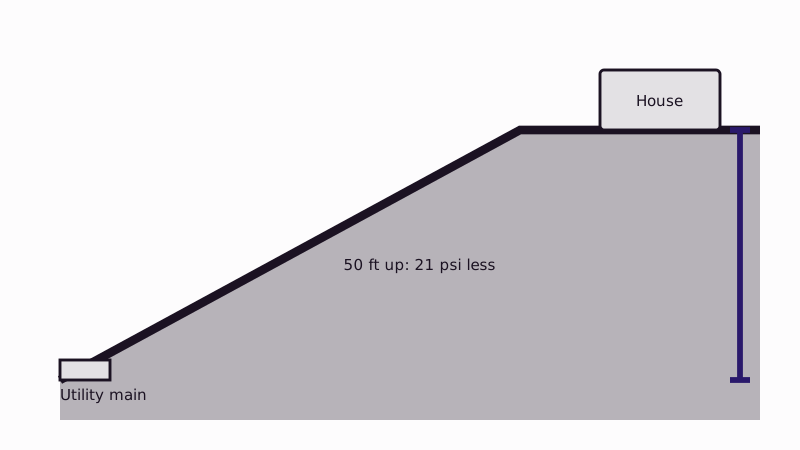
If a hillside house has a good supply but low static pressure, a booster pump may be the answer. Plumbers can size one using the elevation and flow you need. Houses sitting low on a slope face the reverse, with pressure running high, so a regulator earns its keep there. The hillside area pages explain more about each neighborhood: Brentwood, Malibu.
Can a pump increase water pressure in a house?
Yes, within limits: a booster pump lifts pressure only when the supply delivers enough volume, and it cannot cure a clogged pipe or a leak. Expect some noise, an electrical hookup and possibly a permit. Fix restrictions first, and add a pump only when static pressure is still low.
Mounted on the main line, a booster switches on when a tap opens. A pump that demands more flow than the supply can deliver just starves itself. Ask your water utility before installing one, since some utilities set rules for pumps on a service line. Hire a plumber for this: it involves electrical work, pressure settings and check valves.
When is it a plumber job?
Valves, regulators, repiping and pumps are plumber work, as is anything touching the main line or needing a permit. A state contractor license applies to jobs above $1,000. Handle the gauge, aerators and valve checks yourself and pass the rest on.
Have your gauge readings ready when you call, since they shorten diagnosis. The estimate should name what gets replaced, whether the permit is included, and the hours the water stays off. Start on the quote page, or browse the home page for other jobs.
Common questions
How long does a fix usually take?
Aerator and valve checks finish in under an hour. A regulator swap runs one to two hours. A pump install takes longer, and a repipe takes several days. The plumber should give a window once the cause is known, and tell you when water will be off.
Is 40 psi enough for a house?
Many fixtures work at 40 psi, though showers can feel weak, especially on upper floors or with long pipe runs. The California Plumbing Code sets an upper limit of 80 psi for the pressure in a house. The right setting depends on the house, so use a gauge and ask a plumber.
Will a bigger pipe fix low pressure?
Only if narrow pipe is the problem. A larger line reduces friction on long runs or heavy demand, but it does not raise static pressure. If static pressure is low at the meter, bigger pipe inside will not help, and the regulator, valve or street supply is the issue.
Is it safe to turn up my regulator myself?
Some owners manage small gauge-guided changes, but keep it below 80 psi, which is the code ceiling, and stop if the screw binds. Excess pressure strains pipes, fixtures and the heater. Unsure? Let a plumber set it and inspect the expansion tank too, since both matter for safe operation of the plumbing.
Sources used
Page updated