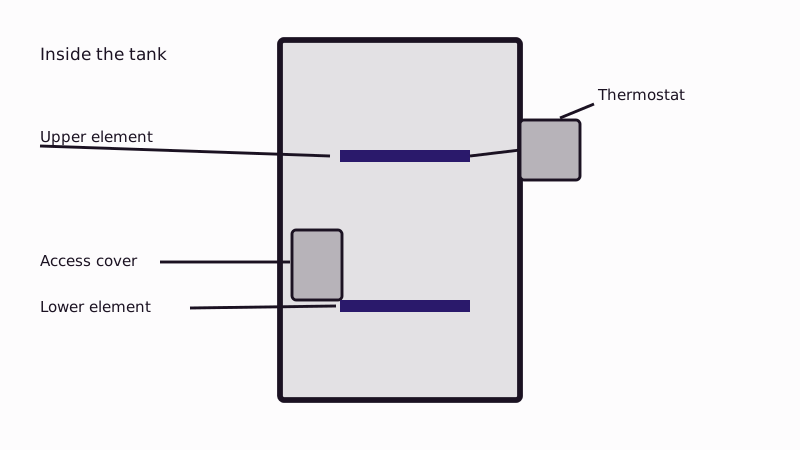
Electric tanks carry a pair of heating elements, upper and lower, either screw-in or bolted on, and each can burn out on its own. Swapping one is a small job: the part costs little and Fixr's national guide puts a replacement element, parts and labor together, at $200 to $750. The wider repair picture is on the water heater repair page. Below is how to know it is the element, and how the swap goes.
What proves the element is the culprit?
Elements show themselves three ways: stone-cold water, a supply that fades within minutes, or a tank that never warms past tepid. A bad upper element usually means nothing heats, since the top element warms the first portion. A dead lower element leaves only a small pocket of hot water. A tripped breaker or reset button should be ruled out first.
A multimeter settles it. Once the breaker is off and a tester shows no voltage, disconnect a wire from the element and read resistance across its terminals. A healthy 4,500 watt, 240 volt element reads roughly 10 to 15 ohms, while an open circuit means the coil has snapped. A reading to the metal flange or tank shows a short. If a meter is new to you, hand this part over.
What is the safe order of steps for the swap?
Breaker off, voltage tested, cold supply closed, an upstairs hot tap opened, then drain the tank to below the element. Remove the access cover and insulation, disconnect the wires, back the old element out with a socket-style element wrench, seat the new one on its gasket, rewire, refill the tank fully, and only then restore power.
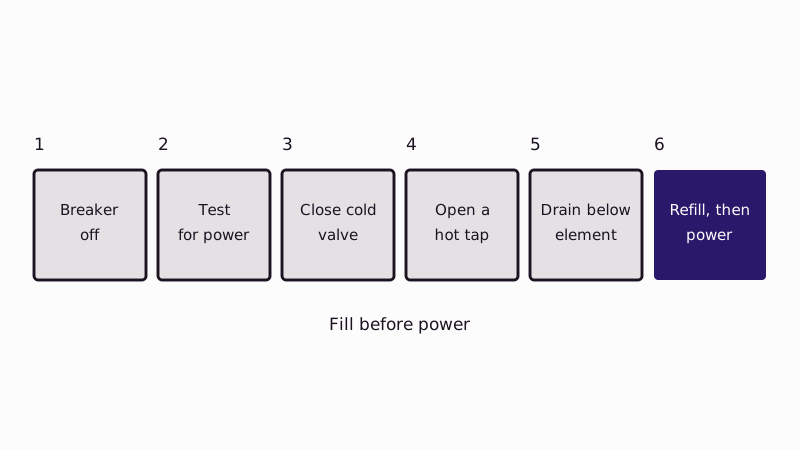
The fill-before-power rule matters most. An element energized in air burns out in seconds, which is the classic repeat failure. Check for leaks at the gasket, purge air at the hot tap until water flows steadily, then flip the breaker. Many people replace both elements together, because the second one is the same age and exposed to the same sediment.
How do I buy the right replacement element?
Match three things from the heater's rating plate: voltage (almost always 240), wattage (commonly 3,800 to 4,500 for residential tanks, but copy what the plate says) and the mounting style, either a screw-in thread or a four-bolt flange. Low-density, shorter elements run cooler and shed less scale, which helps in hard water.
Stock numbers differ by brand, so photograph the plate and the old element before you shop. Do not put in a higher wattage than the plate allows, since the wiring and thermostat are rated for the original load. Brand pages such as Rheem element replacement notes list common part families.
What does a Los Angeles element replacement cost?
Fixr's national cost guide puts an element swap at roughly $200 to $750 with parts and labor, and a thermostat replacement at about $100 to $250. The part itself is a small share, so most of the bill is labor and the visit fee. Read them as a guide, since the real amount comes with the quote for your tank.
What pushes the number up: a tank jammed in a hall closet or hoisted onto a garage platform, a stuck old element that needs penetrating oil and patience, sediment so heavy the tank needs a long flush, and a second failure found when the cover comes off. A heater past 12 years old can tip the decision toward replacement; heater lifespan by age helps with that call.
Which parts of this should stay with a contractor?
Anything that opens gas lines or vents belongs to a contractor, but an element swap is electrical, not gas. It involves 240 volt wiring, so the risk is shock, not fire. If you cannot confirm the power is dead, if the wiring looks scorched, or if the tank leaks around the element port, stop, and call a plumber or electrician instead.
A scorched terminal block or melted insulation means the thermostat or the circuit has a deeper problem, and a new element alone will fail again. Our guide to a no hot water diagnosis covers the other usual faults before you spend on parts.
Why do elements keep burning out in Westside homes?
Mineral scale is the usual cause: hard water bakes a crust on the element, which then overheats and fails. Coastal and hillside areas differ by supplier, so a read of your utility's annual water quality report tells you how hard yours is. Dry firing during a botched swap and a failing thermostat also kill elements early.
A yearly flush and an anode rod check slow scale. If a new element dies within a year, have the thermostat inspected and the sediment depth measured. For deeper tank wear see the guide on anode rod replacement.
Common questions
How long until hot water is back?
About an hour for a straightforward swap, with extra time to drain and refill the tank, so plan on two to three hours before hot water returns. Heavily scaled tanks, stuck elements or a second failed part stretch that. Water heats again after the tank is full and has had time to recover, usually an hour or two more.
Can I replace just one element?
Yes, but a lot of plumbers suggest replacing both when the heater is a few years old, since the second one has lived the same life. If budget is tight, replace the failed one and watch for symptoms. The upper element supplies the first heat, and the lower takes over to finish the tank.
What belongs in the quote?
Part and labor on separate lines, a note on whether the tank is drained and flushed, and a list of what else gets checked besides the element. For anything quoted at $1,000 or above, California requires a contractor license, so look up the number. Insist on the price in writing.
Is it worth the money on an older heater?
If the tank is under about 10 years old and not leaking, an element swap is usually worth it. On a tank older than 12 to 15 years, or one with a leaking base, the money is better held toward a replacement. Have the bottom of the tank checked for rust before you decide.
Does someone need to be there while it is done?
Yes, an adult should open up the heater closet and the electrical panel and agree to any extra findings. With a few hours of work, either stay in or arrange access. Begin on the quote page by giving the brand, tank size and symptoms.
For the wider picture, start with plumber across Santa Monica.
Sources used
Page updated