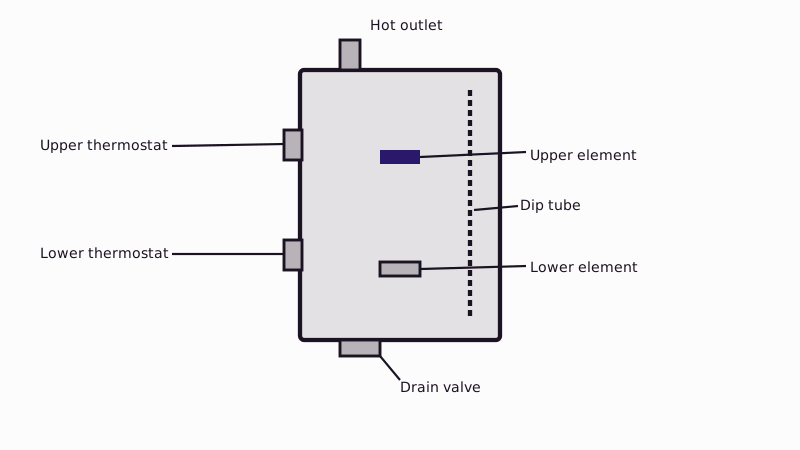
An electric Rheem that went cold is almost always one of four things: no power at the breaker, a tripped high-limit reset, a dead heating element, or a bad thermostat. The first two take minutes to rule out. The last two involve live 240-volt wiring, so many owners are better off passing that stage to a trade professional. See water heater repair for how a visit gets booked.
Which checks come first on a cold Rheem?
Begin at the electrical panel, then the red reset button, and leave elements and thermostats for last. A tripped two-pole breaker or an open high-limit switch is the cheap explanation. A dead upper element usually means nothing hot anywhere; a dead lower element leaves a short supply that fades quickly.
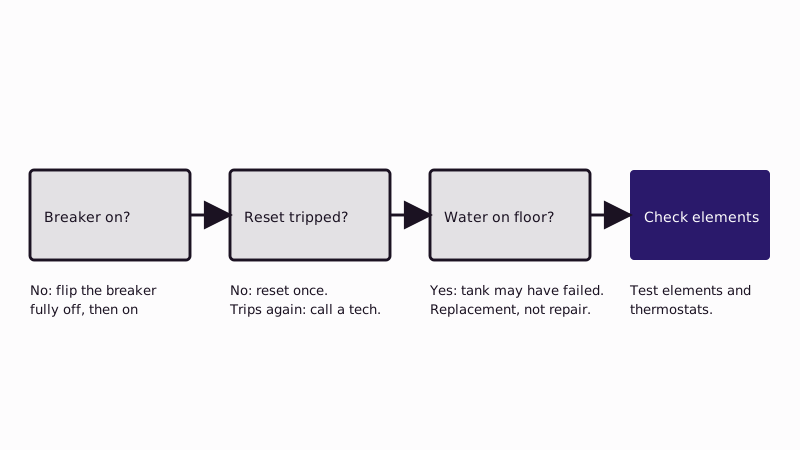
That order matters because every step is free until you reach the parts. Flip the breaker fully off and back on, since a handle can rest half-tripped. Then scan the floor beside the tank: a puddle means a failed tank, which is replacement territory. Access panels come last, and only with power disconnected.
What does the red reset button do, and is it safe to press?
Behind the upper access panel, on the thermostat, sits a red button wired to a safety cutoff. It opens when the water overheats and stays open until a person resets it. With the breaker off, remove the panel and insulation, press the button firmly, close it all up, and bring the power back.
If hot water returns, keep an eye on it for a day. A cutoff that trips a second time points to something making the water too hot: a failed thermostat, a shorted element, a stuck valve. Quit resetting at that stage. Troubleshooting guides citing Rheem's manual say a qualified technician must find the cause, and pressing again and again only hides a fault the device exists to catch. Never bypass the cutoff.
Some newer Rheem models replace the button with a blinking light code. Match the blink count against the manual or the label inside the panel, and jot it down before phoning anyone.
Does the symptom tell me which element died?
Mostly, yes. With the upper element gone you get cool water at every tap, since the upper element heats first and hands off to the lower one. With the lower element gone you get a limited batch of hot water, then cold, because only the top slice of the tank is warming.
A simplified symptom guide:
| What you notice | Likely cause |
|---|---|
| Nothing hot, breaker on | Open reset, upper element or upper thermostat |
| Brief hot spell, then cold | Lower element or lower thermostat |
| Hot, but it drains fast | Sediment on the tank floor or a weak lower element |
| Popping or rumbling | Hardened sediment on the bottom of the tank |
| Water dripping at the base | Tank failure; replacement, not repair |
Proper element testing means cutting power, lifting the wires, reading resistance with a multimeter and confirming 240 volts at the unit. If that sounds unfamiliar, leave it to a plumber. Scale builds faster on elements in hard water, so a heater that keeps losing them may benefit from the hard water and scale advice. The swap itself is walked through in element replacement.
What does a Rheem electric repair usually cost?
According to Fixr, electric water heater repair runs $100 to $650 overall. Within that, a heating element costs $200 to $750, a thermostat $75 to $150 to repair or $100 to $250 to replace, and an anode rod $125 to $300, labor included. The guide's hourly rates span $50 to $150.
Treat these as national guides; the written quote for your house is the real price, itemized the part, labor and any trip charge. A relief valve swap in the same guide costs $100 to $250, and relief valve replacement explains when one is needed. Rheem parts are widely available, but element wattage and thermostat type follow the label's model number, so keep that handy.
Keep the old Rheem or retire it?
Rheem gives 8 to 12 years as normal tank life and gives a rule of thumb: when a repair bill nears half the price of a new unit, put the money toward a new one. Fixing makes sense for a younger heater with no corrosion or leaks. Repeat trouble in a tank aged 10 to 15 years leans toward replacement.
More warning signs on Rheem's list: a leak where the tank meets the floor, rusty hot water, rumbling from hardened sediment, and several repairs in quick succession. Upkeep in between helps; Rheem suggests an annual flush and a fresh anode rod every three to four years against corrosion. The rod job appears under anode rod replacement, and the other half of the decision is in what a new heater costs.
Does a repair or replacement need a permit?
Swapping an element or thermostat usually sits outside the permit a full replacement requires, although jurisdictions differ, so ask the plumber before work begins. Santa Monica's homeowner guide classes hot water heater change-outs as Single Trade Permit work, and the city expects an inspection once the new heater is in.
A replacement also triggers code items that a repair does not: venting or expansion control, earthquake strapping, relief piping. The contractor handling a swap should take care of the permit and the inspection. Big jobs need a state contractor license, deposits are limited by law, and the CSLB site lets you confirm a license number before you sign anything.
Common questions
Where is the model number on my Rheem?
The rating label is stuck to the side of the tank, often near the top or behind the upper panel, and lists model, serial number, wattage and voltage. Photograph it and attach the details to your quote request, so the visit starts with the correct element or thermostat.
Can a failing electric heater raise my power bill?
It can. A thermostat stuck on or an element cycling badly burns extra power, and a tank full of sediment works harder. The page on a broken water heater and a high electric bill covers the signs. An unexplained jump in the bill deserves a look.
Can I do the repair myself?
Only after you shut the breaker, prove the unit is dead with a tester, and feel sure about the wiring. Mixing water and 240 volts is how people get hurt. A leak, a burning smell or any risk of scalding means stop. When that happens, Sunset Coast Plumbing can arrange a local plumber.
Will draining the tank help?
A flush clears loose sediment and can win back lost capacity, and Rheem advises doing it every year. It cannot revive a dead element or reset a safety. A tank that was never flushed may hold sediment that has hardened, and a plumber can judge whether trying is wise.
Sources used
Page updated