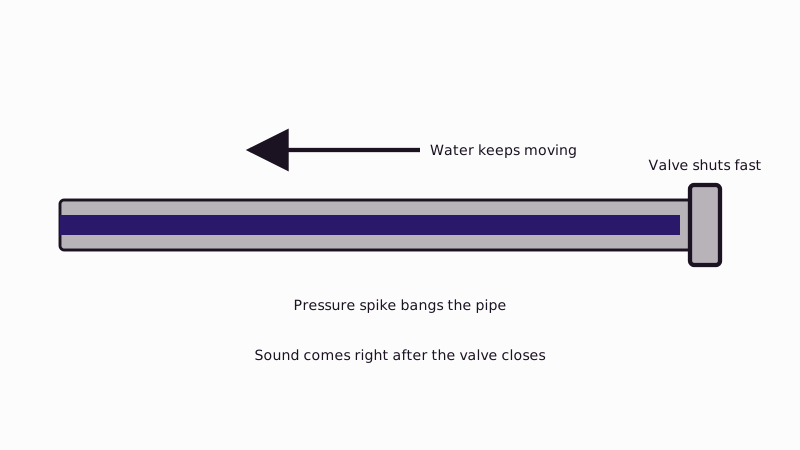
One loud knock in the wall right after the dishwasher stops filling, or a rapid-fire drumming when you shut the shower valve: that is water hammer. A moving column of water carries momentum. Slam a valve and that momentum has no exit, so pressure spikes and the pipes jolt. A fix exists for almost every case. Start below with what the noise tells you, then see what it costs and who should handle it. Other services live on the Sunset Coast Plumbing home page.
What is the sound, and what is going on inside the pipe?
The classic sign is a loud bang, a burst of hammering or a shudder through the pipes right after a valve closes. Wikipedia traces it to flowing water being stopped abruptly, which converts its momentum into a pressure spike. Dishwashers, washing machines and toilets trigger it most, since their valves snap shut.
The surge travels back and forth through the plumbing, which is why you may hear several knocks in a row. The energy has to go somewhere, so pipes strike framing, straps loosen and fittings take a beating. Wikipedia warns that high pressure can break pipes or damage fittings, so a hammer that goes ignored can become a leak.
Not every noise in the wall is water hammer. A buzz while the tap runs, a squeal at one faucet, or a gurgle in a drain each point somewhere else. The test is timing: hammer comes at the moment the water stops, not while it flows.
Which noises are water hammer, and which are something else?
One bang, or a quick string of knocks, the instant something shuts off is the signature of hammer. A rattle that lasts while water runs, a whine at one fixture or a gurgle from a drain points elsewhere: a loose strap, a worn part or a venting issue. Telling them apart is a job for a visit.
Here is a short field guide:
| What you hear | When | Likely direction |
|---|---|---|
| One or several bangs | The moment a valve closes | Water hammer |
| Chatter or vibration | While water runs | Loose pipe, worn valve part |
| Whistle at one tap | While it is open | A restriction or worn part at that tap |
| Gurgle at a drain | After draining | A drain or vent issue, not hammer |
Tell the plumber which fixture sets it off, how often and how loud. Recording a clip on your phone helps more than describing it.
Why does it happen more in some houses?
High supply pressure, long straight runs with nothing to cushion the surge and fast-closing valves make it worse. The state code names 80 psi as the top static pressure allowed. Beyond that a pressure regulator is needed, and a closed system with a regulator often needs an expansion tank downstream as well. Older houses may have neither.
Across the Westside, pressure shifts with the street and the elevation, whichever utility supplies the block. Houses low on a hillside street, as in Brentwood or Pacific Palisades, can receive more than houses higher up. A low-cost gauge screwed to an outside tap, or a plumber's own gauge, shows what your house actually gets.
Older houses add their own quirks. Rigid galvanized pipe in a 1920s Craftsman can carry the knock from room to room. Air chambers that once cushioned the surge can fill with water over the decades and stop working. Washing machine and dishwasher valves close quickly, and modern quiet-fill toilet valves are gentler than old ball valves.
How do you fix water hammer?
Wikipedia lists the usual remedies for houses: a pressure regulator to lower supply pressure, slow-closing or quiet-fill valves, a water hammer arrestor fitted between the pipe and the appliance, an air chamber or expansion tank to absorb fluctuations, and shorter branch pipes. A plumber usually begins with pressure, then moves to the offending appliance.
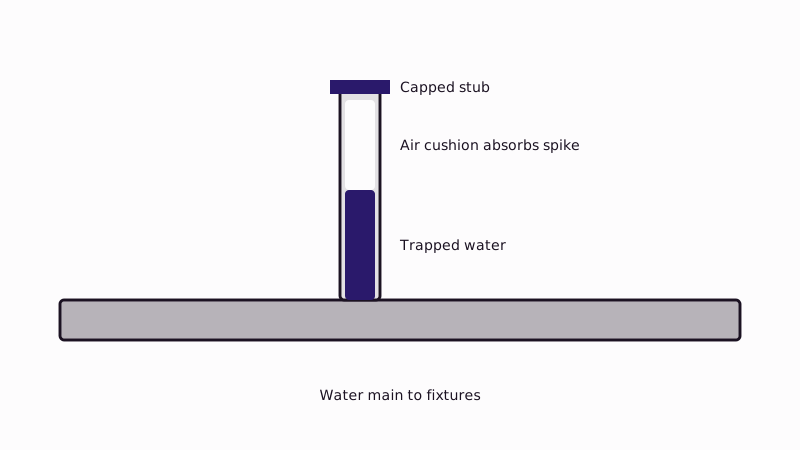
Here is the usual sequence:
- Read the pressure. Anything over 80 psi makes a regulator and expansion tank the first fix. See where the regulator is usually found and how to adjust one.
- Fit an arrestor at the noisy appliance. A hammer arrestor sits close to the washer or dishwasher valve and absorbs the shock.
- Secure loose pipe. Straps and cushioning stop pipes knocking the framing even if some surge remains.
- Check for failed air chambers. On older systems, a plumber can recharge or replace them.
Do not shut a valve slowly by hand as a permanent solution, though closing taps gently helps a little. The goal is to remove the cause, not to live around it.
What will silencing the pipes cost?
Neither arrestors nor regulators have a price in the sources we read; the written quote decides it. What the sources show is the labor side: Bob Vila lists plumber rates from $45 to $200 hourly, plus a call-out of $100 to $350 that often includes hour one. A regulator job has its own page, covered under pressure regulator installation cost.
Quotes vary with access. An arrestor on an exposed washer valve is a short visit. Cutting into a wall for a dead air chamber is not. Ask the plumber to list the pressure reading, the proposed fix and what it covers.
Weigh the cost against what hammer can do over time, such as a cracked fitting or a leak behind plaster. The burst water pipe guide shows how that can end up, and a house-wide regulator is often the cheapest long-term protection.
When does the noise need a plumber, not a DIY fix?
Bring in a plumber if pressure reads over 80 psi, if the knocking comes with leaks or stains, if pipes visibly jump, or if the fix means cutting a supply line. Gas lines and a heater's gas control are off limits for DIY, and the work needs a contractor license when it reaches $1,000.
You can safely look at exposed pipes for loose straps, tighten visible hangers if you can reach them without strain, and note which fixture triggers the sound. Do not apply torque to a line you cannot see, and do not adjust a pressure regulator without a gauge.
A gas smell while you inspect a heater or its closet means everyone exits first. The utility, SoCalGas, is then phoned on 1-800-427-2200.
Work on a heater or the main supply means a local plumber comes to inspect. Our part is arranging the visit; the plumber does the fix.
Common questions
Does the knocking harm the plumbing?
Yes, over time. Wikipedia says high pressure surges can break pipes or damage fittings. A knock that happens a few times a day stresses joints, straps and appliance valves. Small leaks at fittings, loose pipe or a failed washing machine hose are common results. Get the cause fixed before it turns into a wet wall.
Could my water heater be behind it?
It can be linked. Heat raises pressure inside a closed tank system, and a missing expansion tank worsens surges. Still, most hammer begins at a fast-closing valve. The plumber measures pressure and inspects the expansion tank before pointing at the heater. Gas heater safety questions need a contractor, not guesswork.
Will a hammer arrestor fix it?
Often, when the noise comes from one appliance. An arrestor absorbs the shock near the valve that causes it. With pressure past 80 psi, an arrestor only treats the symptom, and a regulator is the proper cure. The plumber should measure pressure first and explain the choice.
Why is it worse at certain times of day?
Supply pressure can climb when demand on the street is low, such as late at night or early morning, so surges may hit harder then. We have no sourced figures for daily swings here, so if the noise comes and goes, ask for pressure readings at different times.
Is it safe to ignore for now?
For a short while, yes, but do not ignore it. Wikipedia describes risks from broken pipes to damaged fittings. If the banging is loud, repeated or paired with leaks, call. If it is a faint tick when the washer fills, ask for a quote at your convenience.
Want the pressure measured? Request it on the quote page; the fix gets a written price after the plumber has measured.
Sources used
Page updated