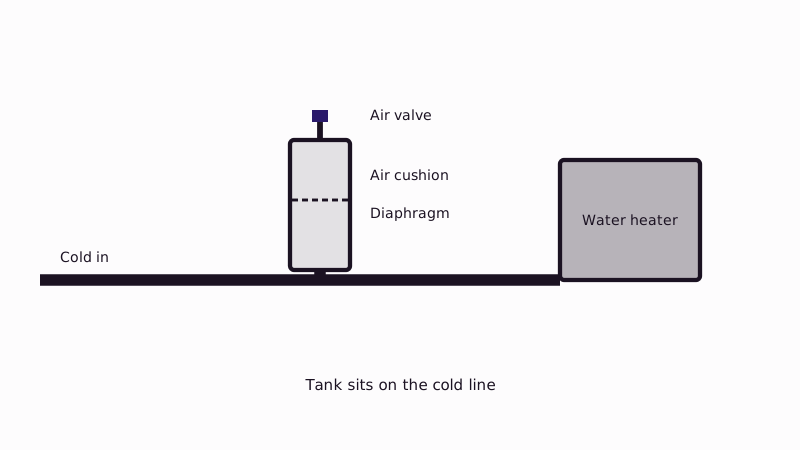
Swap the tank once its air charge or its diaphragm is gone. Two quick checks tell you: knock on it, since a good one rings hollow in the upper half and solid in the lower, and press the small air stem on its side, where a squirt of water means the diaphragm has ruptured. Many tanks last roughly five to ten years, though the number varies by brand and water conditions. Replacement is a short job, usually done alongside water heater repair or a new heater.
What does a thermal expansion tank do, and why do you have one?
Warming water makes it take up more room, and a sealed-off plumbing system gives it none. The tank keeps a cushion of air behind a rubber diaphragm so the extra volume has somewhere to go, rather than leaning on pipes, fixtures and the heater. Leave it out and pressure can jump each time the burner or element runs.
A system turns closed once a device on the incoming line blocks reverse flow to the street, for example a regulator, check valve or backflow assembly. For those, a tank is often needed to control thermal expansion, and inspectors commonly look for expansion control during a heater change-out. A house with an open system, which is rarer today, may not have a tank at all. If you added a regulator, read how a pressure regulator is adjusted for why that matters.
What shows that the tank has quit?
Run three checks. Knock on it; a good tank sounds hollow above the middle. Press the tire-style air stem; only air should come out, and water means a failed diaphragm. Then watch the heater's relief valve and a pressure gauge: a drip, or a gauge that leaps while the heater runs, says the tank isn't absorbing the expansion.
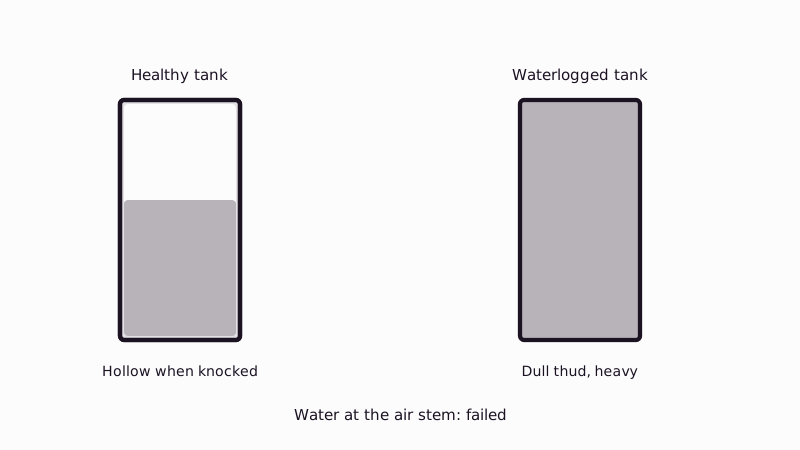
A waterlogged tank sounds dull from top to bottom and feels heavy. Other clues: pipes that bang when the heater kicks on, a dripping T&P valve, spitting faucets, and washing machine or toilet valves that wear out early from repeated surges. Screw a gauge to a hose bib and read it across one heating cycle. A climb well over the resting number is a spike. The plumbing code (CPC 608.2) sets 80 psi as the limit for static pressure, while the EPA suggests 45 to 60.
Can the tank be recharged instead of replaced?
Sometimes. If the diaphragm is sound and only the air has leaked off, a hand pump can restore the charge once the tank is isolated and relieved of water pressure. Water from the stem, or a rusted shell, means replacement. A charge that fades again within weeks points to a leaking bladder.
To recharge, close the cold feed, bleed the line at a faucet, bring the air side to the house's static pressure using a gauge, and reopen the feed slowly. The pre-charge setting is the part that people skip, and it is the whole point: too high and the tank can't absorb expansion, too low and the diaphragm is stressed. A plumber measures the house first and sets the tank to suit. Past ten years, or with corroded fittings, a tank deserves replacement more than coaxing.
What size tank do you need?
Two gallons of capacity is the usual match for a 40 or 50 gallon heater, and bigger heaters or higher pressure may call for more. Sizing depends on heater volume, supply pressure and maximum temperature; the tank label lists its acceptance volume, and the manufacturer's chart or a plumber picks the match.
Too small a tank wears out early or never takes the whole expansion. Weight matters as well: it hangs from the water line and needs support, and in earthquake country a tank dangling from copper can stress its joints in a shake. Ask the installer about the support. Heater type matters too, so tell the installer if yours is tankless or a heat pump.
What happens during the swap?
The order of work: shut the cold feed, cut power or gas, crack a hot tap to release pressure, drain that section, and unscrew the old tank. The replacement goes on with fresh thread tape and a pre-set charge matched to house pressure. Then the supply opens slowly while every fitting is watched for drips.
The job commonly takes under an hour. Gas heaters need the gas control left alone, and the work should not touch gas piping. On a heater swap, the new tank is often installed at the same time, along with a new T&P valve and discharge line. An owner handy with threaded fittings and a tire gauge could do it, but a leak on a pressurized line becomes a flood. A heater in an attic or upstairs closet makes a drain pan worth having.
Does the swap need paperwork with the city?
For a heater change-out, yes: Santa Monica's homeowner guide puts it under the single-trade plumbing permit. A lone tank swap is smaller, but the municipal code's exemptions are narrow, so check with Building and Safety. Other Westside cities set their own rules.
The City of Los Angeles covers Brentwood, Venice, Westwood and Pacific Palisades, and Malibu has its own building office. When a plumber replaces the heater, the permit and inspection cover the tank, bracing, valves and venting. The inspector looks for expansion control, a properly piped T&P discharge and earthquake straps. The longer checklist is in permits for water heaters. Separately, California's contractor license rule applies to work that reaches $1,000.
How does the T&P valve relate to the tank?
When the tank gives out, the heater's temperature and pressure relief valve ends up venting the excess, so a valve that drips every heating cycle hints at a waterlogged tank. That valve exists for safety, so it should never be plugged or capped. Replace one that weeps, and fix the cause.
The two work together, but they are not substitutes. One prevents the spike; the other is the backstop if pressure still climbs. A leaking valve may also be corroded or have hard-water scale on its seat, as covered in replacing a pressure relief valve. When both are original on a 12-year-old heater, replacing the whole heater may be the better plan; for the age question, read replacement timing for the heater.
Common questions
What is a tank's usual service life?
Commonly five to ten years, sometimes longer in gentle conditions. The rubber diaphragm and the air charge wear out, and water hardness and heat cycles shorten that. Test it each year when you flush the heater, and replace it with the heater if both are old.
Does California require the tank?
Not by a blanket rule, but on a closed system a tank is often needed, and inspectors commonly look for expansion control at heater replacements. A house with no check valve, backflow device or regulator may be open, but many have one buried at the meter, so assume a tank is needed until a plumber says otherwise.
What if a closed system runs with no tank?
Pressure rises every time the water heats, which stresses pipes, joints, the heater and valves. You may see a dripping T&P valve, banging, early failure of fixtures and, in the worst case, a split pipe or heater. As parts go, it is inexpensive next to what it protects.
Where does the expansion tank go?
On the cold water line close to the heater inlet, typically above or beside the tank, and supported. The installer or the manufacturer's sheet shows the approved position, which can differ for tankless and heat pump models. Ask the installer to explain why that spot was chosen, since a poorly placed tank can sag or put strain on the fittings.
Could an owner do this alone?
Possibly, if fittings and a tire gauge don't intimidate you, though a leaking union on a pressurized line floods fast. Many owners hand it over with other heater work. Going solo, match the pre-charge to your measured house pressure and watch for leaks over the next day.
Other plumbing visits are listed on the Sunset Coast Plumbing home page.
Sources used
- California Plumbing Code sections 608.2 and 608.3 (pressure limit, thermal expansion), as described in city water heater handouts such as the City of Escondido residential water heater installation guide
- EPA WaterSense Labeled Homes Technical Reference Manual (service pressure 45 to 60 psi, 80 psi limit)
- City of Santa Monica, Homeowner's Guide to permits
Page updated