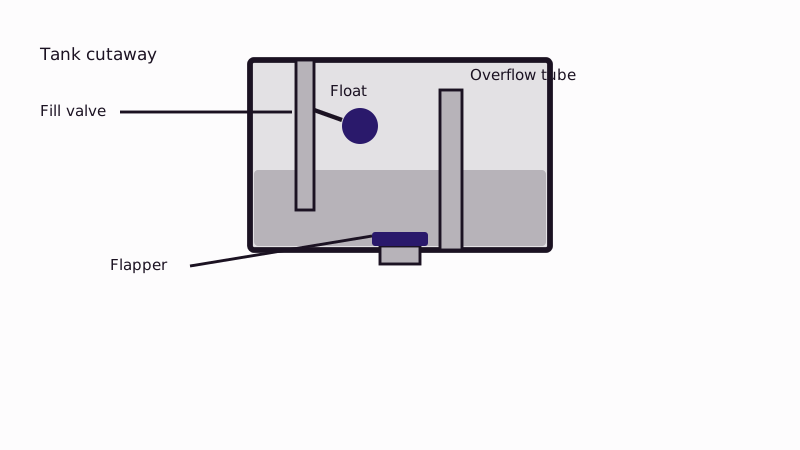
Three clues sort most running toilets in under a minute. Water sliding silently down the bowl wall: a flapper whose seal has failed. A steady hiss while the tank sits full: the fill valve. A refill that stops only when you jiggle the handle: the chain or linkage. Below, each clue gets its own test and its own fix, and the end of the page says when a toilet repair plumber is the better call.
Which clue matches your toilet?
Start with what you see and hear, then match it to a part. Sound is the best guide, because a tank in good shape is nearly silent between flushes. Watch for a quiet minute before touching anything; the table pairs each symptom with a likely cause.
| What you notice | Likely part |
|---|---|
| Quiet trickle, bowl surface shivering | Flapper or its seat |
| Hiss, tank looks full | Fill valve |
| Water pouring into the vertical pipe in the middle | Float set too high |
| Tank refills every few minutes by itself | Flapper (the so-called phantom flush) |
| Runs until you wiggle the handle | Chain tension or a binding handle |
Watch for a full minute before touching anything. Then press down lightly on the rubber flapper with a spoon handle. When the sound stops under pressure, you have found the culprit. Keep the supply valve open during the look; close it only once you start replacing parts.
Is a worn flapper the problem?
Very likely. The EPA describes the flapper as the rubber piece that holds water in the tank until a flush, and says a worn one can set off flushes or leak without a sound. Its advice: inspect it now and then, and do not let one go beyond five years.
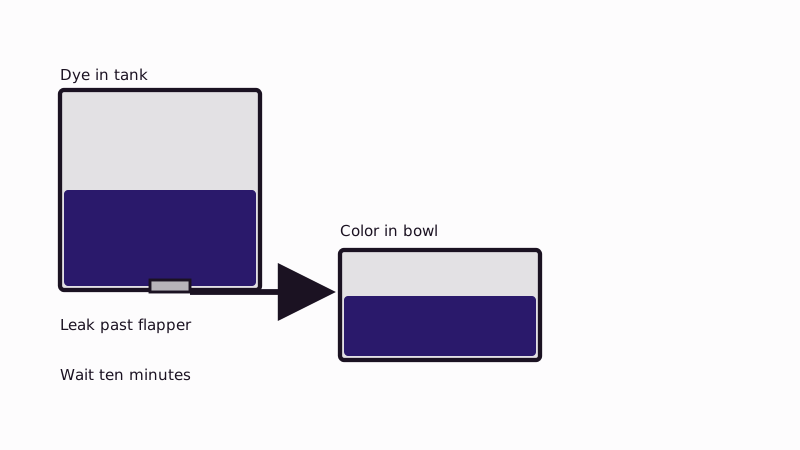
The agency's dye test takes ten minutes. Tint the tank water with a little food coloring, leave the toilet alone, and see whether color reaches the bowl. If it does, water is sneaking past the seal. Flush straight afterward, or the dye stains the tank.
Swapping the part is a short job. Close the supply valve, flush until the tank is dry, lift the old flapper off its pegs and chain, and carry it to the store so the size matches. Scale on the seat can defeat even a brand new flapper, so wipe that ring clean with a cloth before pressing the new part on.
Thumbtack prices flappers and fill valves alike at $5 to $20, the toilet seat excepted.
What if the tank keeps hissing and refilling?
Suspect the valve that fills the tank, or its float. That valve admits water until the float climbs and shuts it off, so a float riding too high, or a valve that has gone soft inside, leaves water flowing into the central standpipe long after the tank should be done.
Look at how the float attaches. Many have a thumbscrew or a sliding clip that lets you lower the shutoff point. Drop it a little, flush and watch. If the hiss persists even at the lower level, the valve itself has failed and needs replacing, which is a boxed kit with instructions printed for the model.
Stop and phone someone if the supply line is rusty, the tank is cracked, or water collects around the toilet's footing. Those are leaks rather than a running toilet, and the repair is bigger.
Why does a running toilet matter so much here?
Because the waste is quiet and constant. The EPA's household average is 9,300-plus gallons a year lost to leaks, and a leaking flapper is a classic source. Water is billed by use, so the loss shows up on a statement sooner or later.
If a bill jumps and you cannot find a wet spot, run the dye test before anything else. The page on a surprisingly high water bill lists the other places water hides.
Older Santa Monica and Culver City houses sometimes still carry original tanks with brass valves and ball floats. Those can be coaxed along, but matching parts is a chore, so many owners switch to a fresh fill valve and flapper kit in one go.
Fix it yourself, or call someone?
Most running toilets yield to a screwdriver and an adjustable wrench. Thumbtack's national guide lists a plumber's toilet repair at $149 to $355, around $230 typical, with simple repairs taking an hour or two and hourly rates of $45 to $150. Bob Vila's service call range is $100 to $350, usually with the first hour included.
Those are national guides. Your own written quote, prepared for your address, fixes the price. For bigger jobs, flush mechanism repairs and full toilet replacement have their own pages.
Hand it over when:
- the bowl is cracked or damp at the floor,
- the supply valve will not turn or weeps,
- new parts fail to quiet the toilet,
- there is a sewer smell,
- the supply line connection is beyond your comfort.
The how-to side is covered in repairing a running toilet step by step, and the two parts behind most callouts have their own pages: the fill valve fix and the flapper fix.
Common questions
The toilet fills itself every few minutes. Why?
Because water is seeping from tank to bowl until the level drops enough to trigger a top-up. A tired flapper is the usual reason. Run the dye test; a colored bowl confirms it. Replace the flapper, and mind the EPA's five-year check interval.
Does it count as an emergency?
Not quite, but do not let it ride for weeks. A running toilet drains water around the clock, and the EPA counts a typical household leak in the thousands of gallons a year. Until you can repair it, shut the valve behind the bowl and open it only when someone needs to flush.
What should the repair cost?
A few dollars for parts, per Thumbtack's $5 to $20, or $149 to $355 for a plumber's visit, about $230 typical, in the same national guide. The part and the time on site drive it. Request a quote that keeps call-out and repair on separate lines.
I changed the flapper and it still runs. What now?
Inspect the seat for scale or a nick, and check the chain length: too short holds the flapper open, too slack lets it snag. Confirm the level stops short of the standpipe's opening. If all that is fine, the fill valve may be failing too.
Can it harm my bathroom?
The water is clean, but a fill valve that never rests wears out early. If the running comes with a crack or a failing seal at the tank bolts, water can reach the floor. Feel around the base for dampness and have a plumber inspect anything doubtful.
Need a hand? The quote page gets a local visit arranged. More services sit on the Sunset Coast Plumbing home page.
Sources used
Page updated