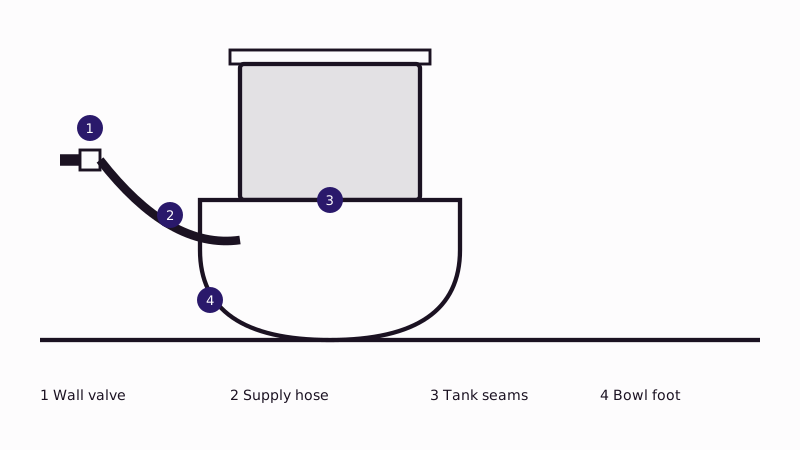
Four places leak on a toilet: the wall valve, the supply hose, the tank seams and the foot of the bowl. Wipe everything bone dry, lay a strip of toilet tissue at each spot, and flush once. Whichever tissue goes soft first is your answer. Foot-of-bowl leaks usually belong to a toilet repair plumber; the rest are often tightening jobs, and a quote is there if they are not.
Which of the four spots is the wet one?
Check them in the order water travels. The wall valve and the hose come first, then the bolts and seam where the tank sits on the bowl, then the ring of floor around the foot. Cracks in the porcelain itself are the fifth, rarer case. The earliest damp patch marks the origin.
Read the pattern. A bead on the wall valve stem suggests a loose packing nut. Trickles that slide down the porcelain from under the tank implicate a tired bolt washer or the seam gasket. Water circling the base, heaviest right after a flush, blames the wax seal or slack floor bolts. A cold tank that beads on a muggy day is condensing, which is harmless.
Leaks you cannot see need a test. For silent leaks, EPA's WaterSense program suggests a dye check: add drops of food dye to the tank, wait ten minutes with no flush, and inspect the bowl. Color arriving there shows the flapper is not sealing. See a toilet that keeps running for that family of faults.
What puts water on the floor beside the bowl?
The wax ring has lost its seal, or the toilet has started to rock. The ring is a soft gasket seated between the bowl outlet and the flange on the drain pipe. Age, a shifted bowl or a settling floor squeezes it out of shape, and every flush then spills a little.
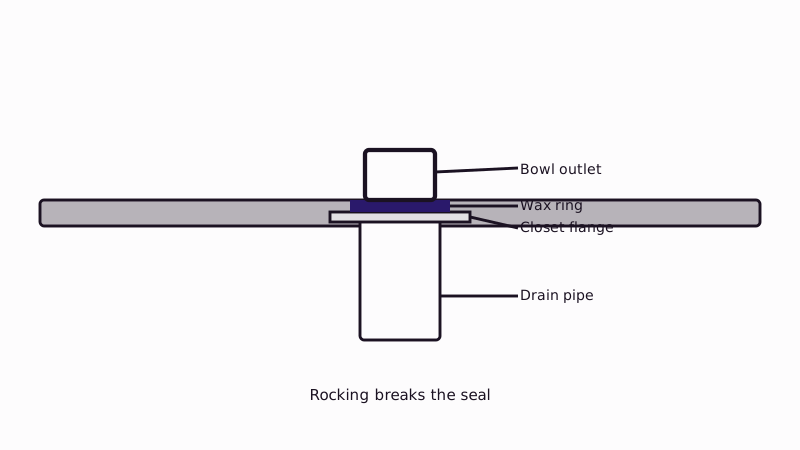
Press down on the rim from the side. Any play is a warning. Take up the closet bolts in small increments; porcelain cracks if you lean on it. If water still shows at the foot, the ring has to be replaced: close the supply, empty the tank and bowl, lift the toilet clear, scrape off the old wax, check the flange, fit a new ring and settle the bowl back down squarely.
Westside bathrooms add wrinkles. Floors in older Craftsman and mid-century homes have often sunk or softened, and cast iron flanges rust. A flange set too low or broken wants a repair ring, and spongy subfloor wants fixing first. A plumber who meets those conditions often saves you a second attempt.
What should you do about a drip beneath the tank?
Replace the bolt washers or the seam gasket. Turn off the supply, empty the tank with a flush, and disconnect the hose, back out the bolts and lift the tank away. New parts go on, and the tank returns level, with the bolts brought up in small alternating turns.
Rubber hardens in mineral-rich water, so renew all the washers together and buy the kit made for your model. A crack in the tank wall is not a lasting epoxy job; a fresh tank or a whole new toilet is the sensible route.
Slow filling, hissing and endless refilling are different faults, with the fill valve or flapper at fault and not the seal. See fill valve repair, flapper replacement and flush problems.
How do you handle a leak at the hose or wall valve?
A quarter turn on the compression nut is the first move. Still weeping? Fit a new braided hose, which is an inexpensive part, or replace the valve if the stem seal is the source. Never force a stiff valve; close the home's main instead and get help.
Old valves are the real hazard. One that has sat untouched for years can seize, drip when finally moved, or crumble. Changing it means shutting the main, which in some older houses is itself corroded. Sweating a new copper valve or threading onto a galvanized stub-out goes faster and safer in a plumber's hands.
A slow drip here still matters. It stains the cabinet or wall and feeds mold. Even a small seep earns a repair when EPA reckons household leaks cost more than 9,300 gallons a year.
How much damage can a toilet leak do?
Plenty, quietly. A seep at the foot soaks the subfloor until it rots, and in an upper-floor bathroom it stains the ceiling below. Soft flooring, discolored grout, a musty smell and a bowl that shifts underfoot all point that way, and a spongy floor means stop using the toilet.
Probe the floor around the base with a screwdriver tip. If it sinks in, the floor has to be opened, which may involve a carpenter as well as a plumber. Delay makes the repair larger.
Tenants are best off emailing the landlord and saving photos. California expects rental homes to have plumbing in working order, and a leaking toilet is the owner's to fix. In a condo, tell the manager at once if water could reach the unit beneath yours.
When does a new toilet beat more repairs?
A cracked bowl or tank qualifies, as do when repairs keep failing, when it flushes poorly, or when it is an older high-flow model. A new toilet also ends leaks from seals you cannot reach, and uses less water per flush.
What you pay hinges on the model and the labor, and only the quote fixes the figure, though what a toilet swap costs explains the pieces. A loose seat or lid is a smaller matter, handled in fixing a loose toilet seat.
Where does the DIY line fall?
For a tightened bolt or a new hose, you probably can manage. A sunk floor, a cracked fixture, a stubborn wall valve, a flange fault or any water damage belongs to a pro. Most toilet jobs finish far under $1,000, the level that triggers California's contractor license rule, and a job with floor work could reach it.
Any deposit stays at or below ten percent of the price, and never over $1,000, and the state's online lookup confirms a license. A quote in writing comes first; the job outline shows how a visit proceeds.
Check the water bill as well. A jump with no clear reason often traces to a silent tank leak, and why a bill climbs lists the other suspects.
Common questions
The toilet only leaks when flushed. Why?
A flush pushes a surge of water through the base seal, so a weak wax ring or loose bolts show up then and not before. Check for rocking first. If the bowl moves or the floor around it feels soft, a plumber should reset the seal and look at the floor.
Is this one for an owner to tackle?
Often an owner can do it: a hose nut, a new hose, or tank bolt washers need only basic tools. A wax ring takes more care and a second pair of hands for the lift. A seized valve, soft floor or cracked porcelain points toward calling a plumber.
How urgent is a leak like this?
Water spreading across the floor, or a shutoff that will not close, means shutting the main and phoning for help. A slow drip tolerates a routine visit, yet it it keeps harming the floor. When the seep is at the foot and the floor is wet or soft, stop using the toilet until it is seen.
What shows a hidden tank leak?
Try dye: tint the tank, leave the flush lever alone for about ten minutes, then peer into the bowl. A colored bowl exposes a leaking flapper. Fit a new one first, as the cheapest cure, and repeat the test afterward to confirm that the bowl stays clear.
This guide is one of many on plumber across Santa Monica.
Sources used
Page updated