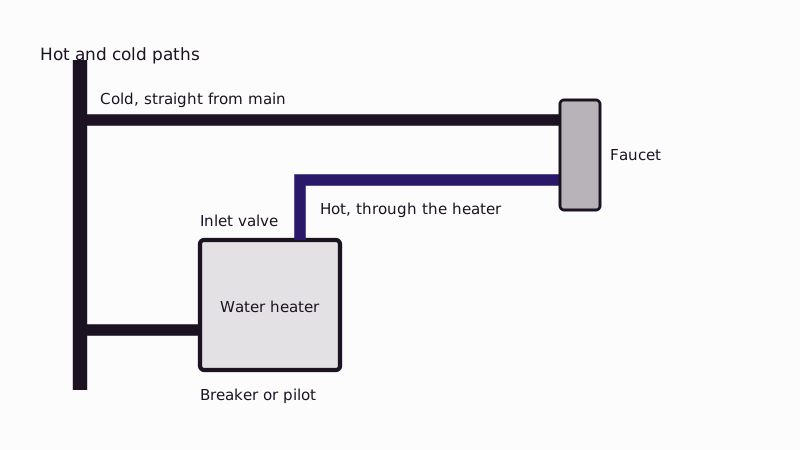
Run the hot tap somewhere else in the house, a bathroom sink or the shower will do. Hot water there? Then the first faucet is the patient: a gritty aerator, a valve that someone left partly closed or a worn-out cartridge. No hot anywhere? Then suspect the heater and its supply. The sink and faucet repair page deals with fixtures; this page narrows down where to look.
Does it affect a single faucet or every hot tap?
Try two hot taps, one of them far from the heater. A single dead faucet implicates that fixture or its own hot branch. Dead hot water at every tap implicates the heater, its shutoff, or its fuel or power. If you get a weak dribble rather than nothing, suspect a half-open valve or a clog instead.
Note what happened just before. If a repair visit or a utility shutoff came first, a closed valve or air in the line is likely. A silent overnight failure points at the heater. A gas or power interruption points at the pilot or the breaker. A few written notes shorten any phone call.
One faucet only: what do I check?
Aerator, then stop valve, then the faucet body. Twist the aerator off the spout tip and check it for grit or white flakes. Beneath the sink, find the hot-side stop valve (usually the left one) and confirm it is fully open. Both fine? A worn single-handle cartridge or a kinked supply hose is the next suspect.
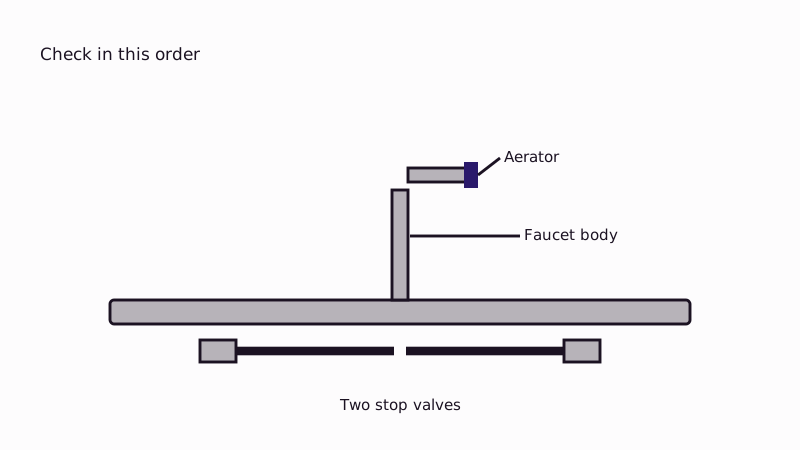
- Aerator: grit gathers here following a repair or a hydrant flush. Rinse the screen.
- Stop valve: easily bumped or left partly closed after cabinet work.
- Cartridge: a worn one can choke the hot side while cold flows freely. The basics of faucet repair sit on the leaky faucet page.
- Supply hose: a crushed braided line pinches the flow. Replace it.
No hot water at any tap: where do I begin?
At the heater. First confirm the cold-water inlet valve above the tank is open. Next, the breaker (electric) or the pilot (gas), and your ears: is a burner or element running? A tank cold to the touch and silent has lost its fuel or power. A tank that is hot but gives no flow suggests a closed or failed valve.
On a gas unit, relight only by the instructions printed on the label. Smell gas at any moment and you walk out, and the gas utility, SoCalGas, is on 1-800-427-2200, and the call is made from outside the building. Anyone in danger? Dial 911 as well. On an electric unit, inspect the breaker first, then the reset button under the thermostat's access panel. A second trip of that breaker is the signal to stop and get a plumber or electrician.
How can cold water run fine while hot gives nothing?
Cold comes straight off the main, while hot must travel through the heater, so anything that blocks the heater circuit starves hot alone: a shut valve at the tank outlet, a failed element or burner, a blocked line. Newer or shared systems add other suspects, such as a recirculation pump or a tankless unit showing a fault code.
A tankless unit that has locked out, or a pump that has died on a loop system, leaves taps dry even when the tank is fine; the unit's manual lists its codes. If you rent, put the problem to the landlord in writing; the apartment no hot water laws page covers the tenant side.
Could trapped air or a recent job explain it?
Quite possibly. After water has been shut off and restored, air can lock a faucet, and a stop valve opened only a quarter turn passes almost nothing. Open the hot tap wide, let it cough and run for a minute or two, and make sure each stop valve is fully open. Spitting that settles is air leaving.
Drained the heater or swapped a faucet lately? Verify that the inlet valve got opened again afterward. Sputtering that keeps coming back suggests a restriction forming in the line, which is a reason to call. When hot water returns, test it with a hand first, because the first surge can be very hot.
Does a leak or weak pressure play a part?
It can. Someone may have closed the heater after a leak, and house-wide low pressure can leave a faraway hot tap feeble while cold looks fine. Puddles beside the tank mean stop: close the water, switch off power or gas to the unit, and book a plumber. The pressure side is in low water pressure.
Leaks hide well; EPA's household average is a loss of 9,300 gallons and more each year, and a leaking heater can announce itself first as a hot-water complaint. If the tank is old, how long a heater lasts helps weigh repair against replacement.
Which signs say this is beyond a homeowner fix?
A heater still cold after the breaker or pilot check. A leaking tank. A breaker that keeps tripping. Several fixtures dead with every valve open. Anything gas-related beyond the label's steps. Faucet-only trouble is often a cheap part, so describe the symptom and let the plumber advise.
Licensing starts at $1,000 in California, so a cartridge or aerator swap is well under it. Heater work, gas piping and venting bring permits and safety rules, so have the scope written down first, using the quote form. Other work is on offer from the home page, and a local plumber travels to you.
Common questions
Can a clogged aerator kill hot water at one tap?
At that tap, yes. The hot and cold paths are separate, and a screen full of grit can choke one side while the other runs. Unscrew it, rinse it and test the flow with it off. If water gushes without the screen, you found the cause, and reinstalling it clean should restore the flow.
Why does the hot tap only work after a long wait?
A heater that cannot keep up, a failing element or burner, or a timer-driven pump can create an on-and-off pattern. A tank that empties and recovers slowly feels like nothing in the afternoon. Log the times and pass them to the plumber. An aging heater may just need service.
Is waiting for a repair risky?
Doing without hot water is more nuisance than emergency, unless the picture includes a gas smell, a leaking tank or water near electrical parts. For those, move at once: leave the building for gas, shut off water and power for a leak. Otherwise just be careful on the first shower after the fix.
Sources used
Page updated