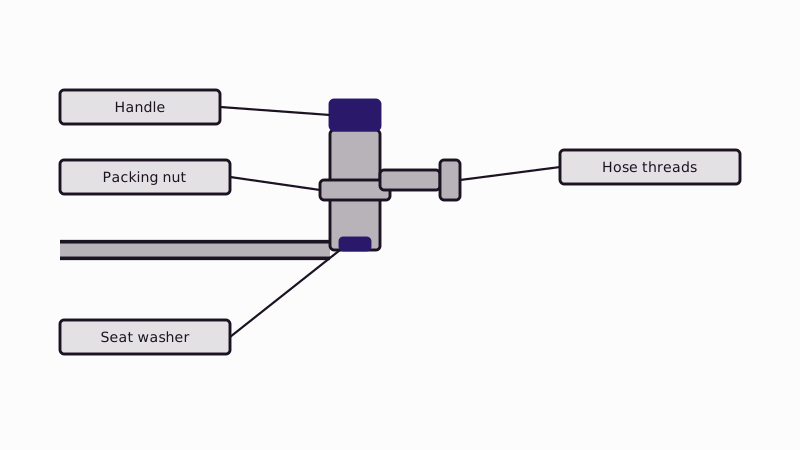
Work out where the water shows. Dripping from the nozzle while the tap is closed calls for a fresh washer. Water seeping around the handle needs the packing nut snugged or the packing replaced. Spray at the point where the hose threads on is usually a cracked hose washer. All three are quick jobs, and the same simple parts also keep indoor sinks and faucets working. Water inside the wall is another matter.
Where is the outdoor faucet leaking from?
Turn the spigot off, dry it, and watch. Water from the spout tip when closed means a worn seat washer. Water creeping out around the handle stem means a loose or tired packing nut. Water at the hose threads only when a hose is attached means the hose washer. Water inside the house or a wet wall means the pipe behind.
Open the faucet partway and watch the handle area: a bead of water running down the stem at that moment is packing. Attach a hose, then turn on, to test the threads. If the vacuum breaker cap on the top spits when you turn it on, the spigot has an anti-siphon device, and that part has its own seat.
A garden hose left attached traps water and speeds wear, so removing it between uses prolongs the faucet's life. Check the hose end washer first, because it costs the least.
What cures a drip from the nozzle?
Stop the water, lift off the handle, draw out the stem, exchange the rubber washer at its tip, then reassemble. The washer presses against a seat inside the body, and when it hardens or wears, the faucet drips even when closed. The washer is a small rubber part and the job takes minutes.
You need a screwdriver and an adjustable wrench. Close the supply first: find the shutoff inside the house on the spigot's own branch, or close the main. Open the tap so the line empties, loosen the packing nut, then turn the stem out. Match the washer size to the old one, and use the right screw. If the seat inside the body is chewed up, a seat dresser can smooth it, though at that point many owners replace the whole spigot.
A single drip a second adds up. EPA's WaterSense pages calculate that letting a tap tick away every second costs roughly 3,000 gallons annually, as EPA figures it, which makes a nozzle leak worth fixing soon. The same agency also reminds owners to check the hose connection, where a worn washer is a common loss.
What if water seeps out around the handle?
First try nudging the packing nut round by a quarter. If it keeps weeping, close the supply, remove the nut, then wind graphite string or fit fresh packing around the stem before threading the nut back on. The leak at the handle comes from the seal around the stem, not from the valve itself.
The packing is a small seal that keeps water from creeping up the stem while the faucet is open. Tighten it gently: too much pressure makes the handle hard to turn. A handle that wobbles or a stem that is corroded may need the whole stem replaced, and a repair kit made for your faucet is easy to find.
For indoor taps with the same fault, the indoor version is in fixing a leaky faucet, with the walkthroughs for bathroom sink faucets and tub faucets.
And when it is the hose end that sprays?
Drop a fresh rubber washer into the hose coupling and snug it with your hand. If the hose still sprays, the threads on the spigot may be worn or the hose end is cracked. Most hose leaks are the hose, not the faucet. A fresh washer and a new hose end are small parts.
Pliers are not needed, and over-tightening damages the brass. Seat a new washer in the female end, snug it with your fingers, and only then add a small wrench turn if it still seeps. A vacuum breaker on a newer spigot is a small plastic or brass cap that prevents backflow into the home's water, and it leaks if its internal parts wear. Replace the breaker cap as a unit.
Hoses connected to irrigation or a pressure washer can create backflow, and some systems need a tested device. When that applies is covered under backflow prevention testing.
Could the pipe inside the wall be the source?
Look for dampness on the exterior wall around the faucet, stains on the siding, peeling paint, moss, a soft spot in the stucco, or dampness in the crawl space or the garage side of the wall. Wetness appearing only when the faucet is turned on suggests a leak in the pipe behind it.
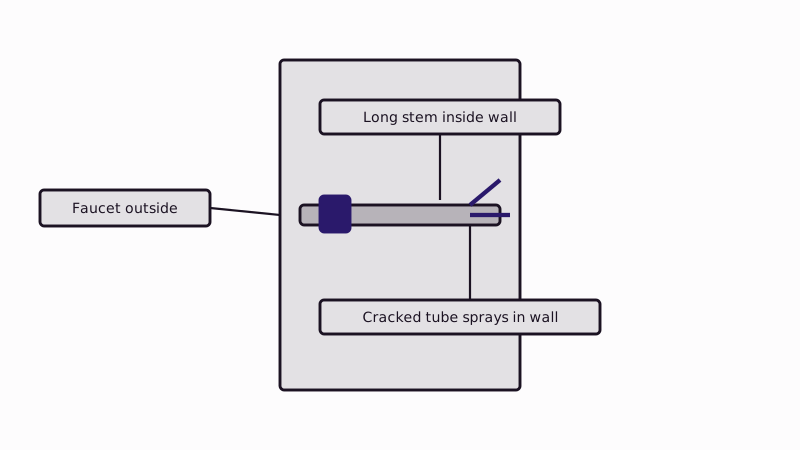
Frost-free faucets have a long stem that reaches inside the heated wall, with the washer at the inner end. If the stem or its tube cracks, water sprays inside the wall every time the faucet runs, and you may never see a drip outside. Pulling it out and checking the inner length shows damage.
This is the moment for a plumber. A hidden leak can rot framing and grow mold with little to show for it, and the repair may involve cutting open stucco or drywall. Get a written price first. Licensing rules for contractors kick in at $1,000 of work and materials, a line that wall repairs can cross.
Does Santa Monica weather change how you fix it?
Mostly no, because freezes are rare on the coast, but not never. Canyon and foothill areas can see cold nights, and a hose left on in a freeze can split the pipe. Salt air corrodes brass fittings near the beach, so a coastal spigot can seize or leak sooner.
Hose bibs on older homes, such as Craftsman and Spanish Revival houses in the Westside, may be old compression types with galvanized or copper supply behind them. Replacing the spigot can disturb that pipe, and brittle galvanized stubs break when twisted. That risk is worth a plumber's care.
Water use matters here too. A leak that runs unnoticed in a yard is a waste in a region that has had drought rules. Check outdoor faucets when you read your meter or when a bill is higher than expected, and the checklist under a high water bill helps.
Is it time for a new spigot altogether?
A cracked body, stripped threads, a stem too corroded for a washer swap, or two failed repairs all justify a new one. A new spigot is a standard part, and swapping one on a threaded or sweat connection is straightforward for a plumber.
On copper, a replacement needs soldering or a push-fit connector, and a bad fit leaks inside the wall. Cutting the water, draining the line and testing carefully matter. Renters are better off telling the landlord in writing instead of attempting a wall repair. Deposits on bigger jobs may reach ten percent of the price but never more than $1,000, and the state's license search confirms a contractor.
The job outline shows how a visit works, and a quote for a spigot swap is one click away.
Common questions
Why does my outside faucet drip when it is off?
The rubber washer at the end of the stem has worn or hardened, so it no longer seals against the seat. Replacing the washer fixes most drips. If the seat itself is damaged, a seat dresser or a new faucet is the alternative. Shut off the supply before you start.
Can I stop the leak without turning off the water?
Not safely. Even tightening a packing nut can release a spray if the stem moves. Close the shutoff for the line, or the main, open the faucet to drain it, and then work. A seized or buried shutoff means it is plumber time.
Is mine a frost-free model?
Frost-free faucets have a long body, often many inches deep, that extends into the house. The handle sits outside and the valve seat sits inside the heated space. A standard spigot is short, with the seat close to the handle. If you are unsure, check the model on the body.
Repair or replace the hose bib?
A washer or packing fix costs very little and often works. Swap the faucet when it is cracked, corroded or already repaired once. Both are small jobs compared with the cost of water damage inside the wall, so do not leave a leak for long.
This guide is one of many on the plumber guide for Santa Monica.
Sources used
Page updated