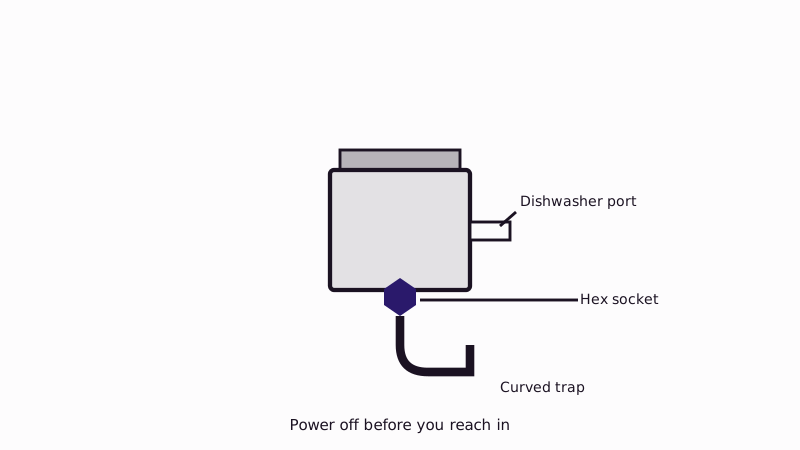
Cut the power first, then clear the clog from above with a plunger or from the side of the unit with a hex wrench. Never reach in by hand, even with the switch off. Nearly every disposal clog lives either in the grinding chamber or in the curved trap just beyond it, and an owner can reach both. Deeper trouble belongs to a drain cleaning visit; to start one, use the quote page.
What comes first, before any tool touches the sink?
Turn off the wall switch, then unplug the unit or flip its breaker, because a switch can be bumped. Shine a flashlight down the opening, hands well clear. Tongs or long pliers can lift out visible objects such as a bottle cap or a piece of silverware.
Power is the one rule you cannot skip. The blades are driven by a motor that can start the moment someone flips the switch, and an injured hand is far worse than a plumber's fee. If the unit is hardwired and you cannot find the breaker, stop and call.
Also check what went down. Stringy vegetables, corn husks, swollen rice or pasta, eggshell grit and coffee grounds are the usual offenders. Grease is the other. Knowing the material tells you whether to expect a jam, a sludge or a plug downstream.
What if the motor hums but nothing spins?
A hum with no spin means the flywheel is locked by a jam. With the power dead, fit a hex wrench into the socket at the middle of the unit's underside and rock it left and right until the wheel moves without resistance. Then press the small red reset button under the housing and bring the power back.
Many units have that hex socket on the bottom; check your model's manual if you cannot find it. If the wrench is not in the box, a standard Allen key of the right size often fits. Turning the flywheel by hand is safe only because the power is off.
If the unit stays dead after a reset, the motor may have failed or the overload tripped repeatedly. A disposal that trips again and again is telling you something, and garbage disposal repair covers what the next steps look like.
How do you clear a clog that sits in the drain?
Pour in some water, enough to cover the drain opening, and plug the second side if the sink has two. A cup plunger seated over the disposal opening, worked with vigorous strokes, often breaks up a soft plug. Where a dishwasher air gap sits on the countertop, a damp rag over it holds the pressure in.
When plunging changes nothing, suspect the curved trap or the stretch beyond it. Slide a bucket under the sink, unscrew the slip nuts, lower the trap and scrub it out. A trap holds food particles and grease that never leave the house, and cleaning it often fixes the problem that seemed to be in the disposal.
Do not reach for a chemical drain product. It will not reach a jam in the blades, and it leaves caustic liquid sitting in a unit you are about to open. Never pour any such product into a disposal and then try to plunge it, because splashback is a real hazard.
See clearing a kitchen sink for the broader sequence when the problem is not in the disposal at all.
What if the dishwasher drain is part of the problem?
It often is. The dishwasher hose connects to the side of the disposal through a small port, and food that cannot pass into the disposal can back up into the dishwasher. New installations require a knockout plug to be removed first, and a plug left in place stops the dishwasher from emptying.
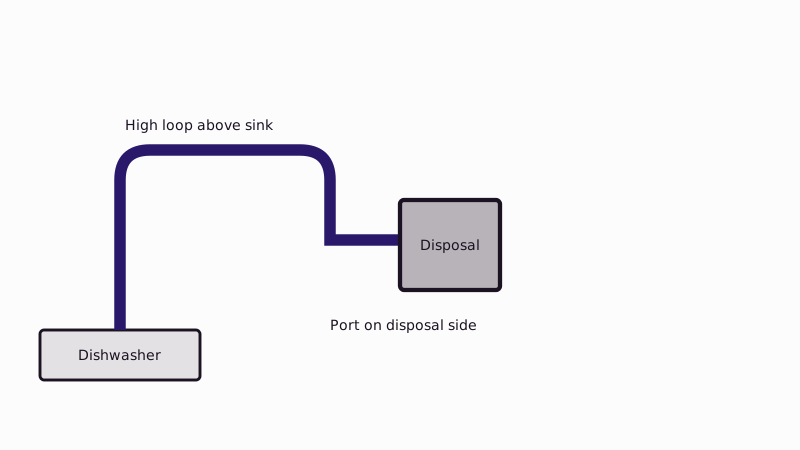
Check whether the dishwasher fills with dirty water or the sink bubbles when it runs. If so, the connection between the two may be blocked, or the high loop in the hose may be missing. Our guide to unclogging a dishwasher drain tracks that path.
Installing or swapping a disposal is a job with plumbing and electrical sides, so it is worth knowing what a pro handles. The page on disposal installation shows the usual scope.
What makes the blockage return?
Because something upstream is feeding it. Grease poured down the sink cools and coats the pipe, and every pass of food waste adds to the coating until it narrows. A disposal does not clean the pipe, it only chops waste so it can travel, and the remainder piles up in the trap and the line.
Old homes make it worse. Many Santa Monica and Westside kitchens from the 1920s to 1950s still run a cast iron or galvanized waste line behind the wall, rough inside and prone to scale, so scraps catch more easily. A camera sent down the drain will reveal a rough patch or a low spot.
Many manufacturers advise running cold water while the unit works and for a short while after, and feeding scraps in small amounts. Hot water can carry melted grease down the pipe, where it solidifies out of reach.
Which signs mean the sink needs a professional?
Water rising in both basins, a blockage that reappears inside a week, sewage odor, a leak from the housing, or blades that will not move for the wrench: each of these points at the branch line, a failed seal or a burned-out motor.
When the kitchen sink and a second fixture, such as a laundry standpipe, means the blockage is past the kitchen branch. A cable machine reaches it, and attempting that with a household snake can damage a disposal or push the plug deeper.
A simple clearing stays well below $1,000, the point where California expects a contractor license, while a replaced waste line crosses it. Scope sets the price, so the written quote decides, and any deposit tops out at ten percent of the price or $1,000. The job outline shows how a visit begins.
What habits keep the disposal clear for good?
Keep cold water flowing as the unit grinds and for a short while after. Feed scraps a handful at a time, and send stringy, starchy and greasy leftovers to the trash instead. Scrape plates before they reach the sink, because the chamber is for small leftovers and not whole meals, and the pipe downstream cannot carry what the blades cannot shred.
Citrus peel and a splash of dish soap freshen the unit, but they do not fix a clog. A monthly rinse with a full sink of hot tap water and a quick burst of the disposal helps keep the trap moving. On an aging unit, repeated service visits can outrun the price of a new disposal.
If the disposal sits under a sink with cabinet crowding, leave the door open when you work so you can see the trap and the connections. A flashlight and a bucket are the whole toolkit.
Common questions
Can you unclog a disposal without a hex wrench?
Sometimes. With the power off, a wooden spoon handle or broom handle pushed against a blade from above can free a minor jam, but never use your hand. A hex wrench from the bottom is safer and gives better leverage.
What happens if I pour drain cleaner into the disposal?
It can eat seals, corrode metal and leave caustic liquid in the chamber, risky for whoever works on the unit later. If it already happened, wear gloves and eye protection near the sink, leave the unit off, and name the product to the plumber.
Why is water coming out of the other sink basin?
The two basins share a drain, so a clog past the join pushes water into the second side. That points to a plug beyond the disposal, further down the drain. Plunging with the other drain blocked often helps, and a cable may be needed.
What time should a professional visit take?
A jam or a trap cleaning is usually brief, while a dead disposal or a branch blockage stretches longer. Ask for the estimate when the quote is written. Before the visit, clear the cabinet beneath so the plumber reaches the pipes without moving your things, and keep pets and children out of the kitchen while the work goes on.
For the wider picture, start with Sunset Coast Plumbing plumber.
Sources used
Page updated