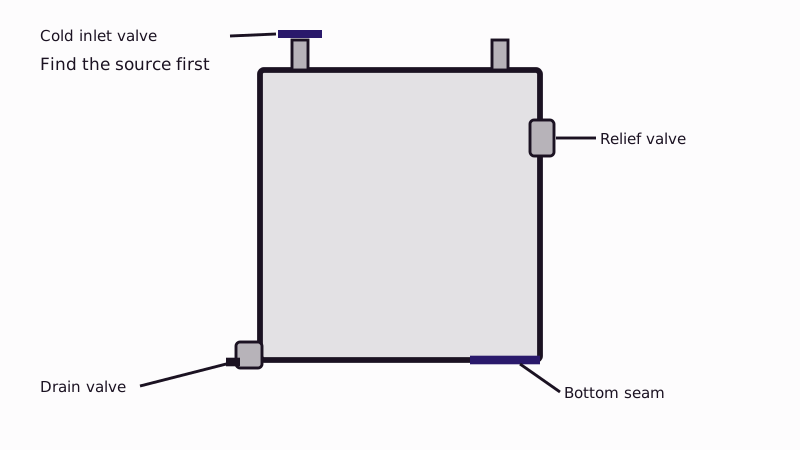
Puddle by the tank? Turn the blue inlet handle clockwise, then cut the electricity or point the gas knob to off. After that, dry the floor and watch for twenty minutes to see where the drip forms. Fittings, valves and the drain spigot can be fixed. Water coming from the metal shell means the tank is finished. The bigger picture is on the water heater repair page; this page covers the leak hunt.
How do I find the exact spot the water comes from?
The source decides everything. A leak at a pipe fitting, the relief valve, the drain spigot or the anode rod port is a repair. A leak seeping from the bottom seam, the jacket or from beneath the insulation almost always means the inner tank has corroded through, and no patch will hold.
Dry everything with a rag and tape a sheet of paper towel under each suspect: top connections, the relief valve plus its pipe, the side port, the drain valve, the bottom pan. Wet paper shows the winner. Condensation can fool you, especially on gas models that vent hot exhaust into a cold closet, so make sure the drip keeps coming after the unit has sat idle.
What do I shut off first, and how fast?
Cold supply first, then heat. The blue-handled valve on the inlet pipe stops fresh water from feeding the leak. Next comes heat: the breaker for an electric tank, the control knob for gas. Opening a hot tap upstairs lets air in so the tank drains cleanly if you decide to empty it.
Do this in that order because an electric element left powered in a half-drained tank burns out in minutes. Gas is its own matter: a whiff of it means walking out, then SoCalGas, 1-800-427-2200, gets the call from outside. Real danger gets 911. Homes in Brentwood or Malibu with long hillside runs can have the main shutoff near the street meter, so find it before you ever need it.
Which leaks can I stop myself?
Three are realistic at home: a weeping pipe connection, a dripping relief valve and a drain spigot that will not seal. Connections often just need snugging by a quarter turn, or fresh thread tape and dope. A cheap drain valve screws on in minutes after draining below it. A relief valve that drips steadily may be faulty or may be reacting to high pressure.
Never cap, plug or tee into the relief valve's drain line. It is the safety vent. If it runs after every heating cycle, pressure from heated water with nowhere to go is a frequent cause, and the cure is an expansion tank rather than a new valve. Relief valve replacement walks through the swap, which on gas models counts as gas-adjacent work, so be honest about your comfort level.
Can a leaking tank body be patched?
No. Epoxy, sealant sticks and tape are not rated for a tank holding pressurized hot water, and the steel around the pinhole is already thinned. Treat a body leak as a replacement job. Photograph the data plate: many makers cover shell failure for a stated number of years, and the serial number proves the date.
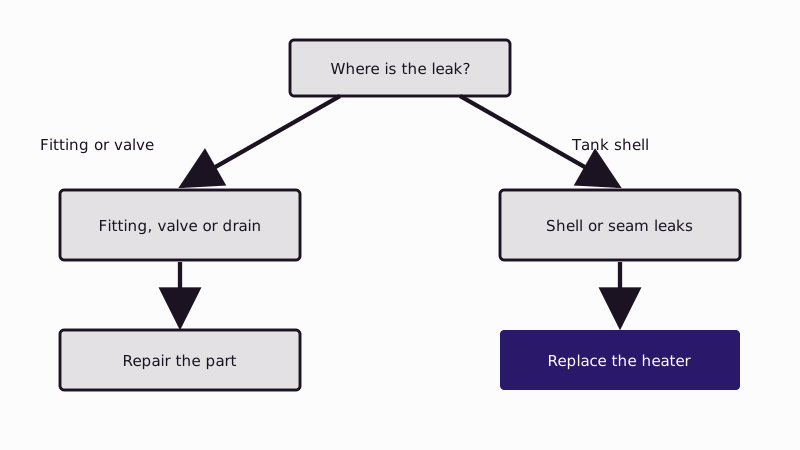
Plan the replacement around the permit rule: California expects a city permit for a replacement tank, and the new unit needs earthquake strapping. The prices run higher than a repair, so check new heater pricing before you ring around. If you are weighing gas against electric, the tank versus tankless comparison covers the trade-offs.
Is repairing a hot water heater worth it?
When the leak is a fitting, valve or drain on a heater under roughly 10 years old, yes: parts cost little and labor is short. When the shell leaks, or the unit is past 12 or 15 years, spend on a new one instead. Fixr's national guide puts typical water heater repairs at $150 to $750, and an urgent weekend call can cost more.
A useful test is the half rule. If the quote is near half of a replacement, buy the replacement. Brand rarely changes that math: Rheem, Whirlpool and Bosch leaks follow the same anatomy, though tankless units leak at the heat exchanger or inlet filter instead of a tank seam. Run your numbers using the guide to how often heaters get replaced.
Common questions
Is a slow drip really worth fixing?
EPA WaterSense estimates the typical household loses above 9,300 gallons annually, and heater drips add to it. Beyond the waste, even a trickle can rot a closet floor or the drywall behind it. A drain pan with a pipe to a safe spot limits the damage.
Does a drip mean calling someone tonight?
A slow drip is urgent but can hold until a visit is booked. A spray, or a floor that keeps filling, cannot. Either way, close the supply and the energy first. Water near a panel, outlets or a gas heater's burner needs the breaker off and a call quickly, and nobody should stand in standing water near live circuits.
Why is the relief valve pipe wet?
That pipe only carries water when the valve opens, either because pressure or temperature crossed its limit, or because the valve seat is worn. Screw an inexpensive gauge onto an outdoor spigot to read pressure. Anything steady above about 80 psi justifies a regulator, and if pressure is fine the valve is likely tired.
Can I get an emergency hot water heater repair after hours?
Open the quote page and state the heater is leaking now. We handle requests Monday to Friday, 9am to 5pm; so the shutoff steps above carry you through nights and weekends. No visit time is promised in advance; that depends on the plumber's calendar.
What should I verify before agreeing to a job?
Ask for numbers in writing and for the name of whoever files a replacement tank's permit. Jobs from $1,000 upward require a California contractor license, so paste the number into the state board's lookup and see that it shows as active.
For the wider picture, start with plumber across Santa Monica.
Sources used
- EPA WaterSense, Fix a Leak Week
- Fixr, water heater repair cost
- SoCalGas, emergency information
- California Contractors State License Board
- Published Los Angeles water heater repair prices from national cost guides, read November 2026
Page updated